



TL;DR:
- Ethical debt collection in the UK involves fair, proportionate recovery methods that comply with FCA regulations and treat customers with respect. Businesses must pause recovery efforts when customers signal financial difficulty and record vulnerability factors to support tailored assistance. Effective practices include offering affordable repayment plans, clear communication, and using vetted, compliant agencies to improve recovery rates and customer trust.
Ethical debt collection means recovering what is owed through fair, proportionate methods that comply with FCA CONC and the Consumer Duty (PRIN 2A). The immediate action every UK business must take: pause active recovery and record a vulnerability check the moment a customer signals financial difficulty or confirms they are working with a debt adviser. That single step sits at the heart of responsible debt collection practices under the Credit Services Association (CSA) common principles and is the baseline the FCA expects. Done well, it also works. Customers who feel treated fairly are more likely to engage voluntarily, which means fewer disputes, lower complaint volumes, and better recovery rates.
Table of Contents
- What does ethical debt collection look like day to day?
- What UK regulations govern fair debt recovery?
- Does your organisation have a published ethical collections policy?
- How do you identify and support vulnerable customers?
- How should you communicate during collections?
- What governance and training does ethical collections require?
- When is enforcement lawful and proportionate?
- How Debt recovery hub helps operationalise ethical collections
- Key takeaways
- Why ethical collections are a business decision, not just a compliance one
- Start recovering debt through a vetted, compliant partner
- Useful sources and further reading
- FAQ
What does ethical debt collection look like day to day?
Ethical collections are not simply about avoiding harassment. They require a deliberate set of behaviours that staff must follow on every account, every contact.
Core principles in practice:
- Forbearance and due consideration. Offer affordable repayment options before escalating. Allow time for the customer to access free debt advice before pursuing further action.
- Proportionality. Match the intensity of recovery activity to the circumstances. A customer who has just lost their job needs a different response than one who has ignored twelve contacts.
- Clear, honest communication. State who you are, what is owed, and what the customer’s options are. Never imply consequences you cannot or will not carry out.
- Verification before pursuit. Confirm you are contacting the right person before making any demand. Pursuing the wrong individual is a CONC breach, not just an embarrassment.
- Sustainable repayment plans. A plan the customer cannot realistically maintain helps no one. Base proposals on a genuine income-and-expenditure assessment.
- Suspension while a plan is being developed. Suspend active recovery for a reasonable period when a customer or their representative is working on a repayment proposal.
Behaviours that are never acceptable:
- Pressurising customers into lump-sum payments they cannot afford
- Threatening court action as a tactic rather than a genuine next step
- Contacting customers at unreasonable hours or through channels they have asked you to stop using
- Ignoring a dispute and continuing to demand payment without investigating
The practical benefit of getting this right is real. Firms that use flexible, person-centred processes report better voluntary repayment rates and fewer formal complaints — and that outcome is grounded in FCA CONC 7.3 guidance.
What UK regulations govern fair debt recovery?
The binding framework for any UK business engaged in consumer debt collection rests on three pillars: FCA CONC, the Consumer Duty, and pre-action protocols.

FCA Consumer Credit sourcebook (CONC). CONC Chapter 7 sets out the detailed rules on arrears, default, and collections. CONC 7.3.2 R requires firms to treat customers in or approaching arrears with forbearance and due consideration, assessing individual circumstances and allowing reasonable time to repay. CONC 7.5 addresses disputed debts: firms must investigate promptly and not continue demanding payment without providing a clear basis for rejecting the dispute. CONC 7.14 adds that where a firm rejects a repayment proposal, it must supply a written explanation of the reason.
Consumer Duty (PRIN 2A). In force since July 2023, the Consumer Duty requires firms to deliver good outcomes for retail customers across four areas: products and services, price and value, consumer understanding, and consumer support. Collections activity sits squarely within consumer support. A firm that uses rigid scripts and fails to capture vulnerability nuance risks breaching the Duty because it cannot demonstrate it has acted in the customer’s interest.
Pre-action protocols and insolvency protections. Where enforcement involves property or significant sums, specific pre-action protocols apply. Firms must not pursue enforcement where an insolvency order or moratorium is in place.
| Obligation | What it requires | Evidence to keep |
|---|---|---|
| Forbearance (CONC 7.3.2 R) | Assess individual circumstances; allow reasonable time to repay | Income-and-expenditure records, notes of adjustments offered |
| Suspend recovery (CONC 7.3) | Pause active pursuit while a repayment plan is being developed | Date of suspension, trigger event, restart criteria |
| Disputed debt (CONC 7.5.5 R) | Investigate; do not demand payment without justifying rejection | Dispute log, investigation outcome, written response |
| Payment reconciliation | Process payments within five working days of receipt | Payment ledger timestamps, reconciliation reports |
| Rejection of proposal (CONC 7.14) | Provide written explanation when declining a repayment proposal | Copy of written response, date sent |
| Identity verification (CONC 7.5) | Do not pursue someone known not to be the borrower | Identity check records, assignment notification log |
| Referral to debt advice (CONC 7.3) | Inform customers that free, impartial advice is available | Referral log, call transfer records |
Additional compliance notes:
- Payments should be reconciled within a timely manner per FCA guidance on payment processing.
- Firms must not use premium-rate phone numbers for calls likely to last longer than 15 minutes; calls by customers to check account status should not reasonably exceed five minutes under CONC 2.6.
- Where a regulated credit agreement is assigned, the customer must be notified as soon as reasonably possible.
Does your organisation have a published ethical collections policy?
A policy that exists only in a shared drive is not a policy. It needs to be published, owned, approved at board level, and tested against real cases.
Policy essentials to publish:
- Scope: which debt types and customer segments the policy covers
- Named policy owner with contact details
- Board approval date and next scheduled review date
- Escalation limits: the point at which a case must be referred to a senior manager or legal team
- Complaints route: how customers raise concerns and the expected response timeline
- Review cadence: at minimum annually, or after any significant regulatory change
Operational clauses to include:
- Vulnerability screening process (see Section 5 below)
- Pause rules: automatic suspension of recovery when a customer confirms engagement with a debt adviser
- Sustainable repayment criteria: minimum income-and-expenditure assessment before any plan is agreed
- Payment reconciliation timelines: five working days as the standard
- Acceptable communication channels and hours: no contact before 8 AM or after 9 PM; no premium-rate numbers for extended calls
- Rejection communication template: a written explanation whenever a repayment proposal is declined, per CONC 7.14
Controls to evidence compliance:
- Staff training records with completion dates and assessment scores
- Agent oversight logs and call recording retention schedule
- Audit schedule: at minimum quarterly case sampling
- Third-party assurance documentation for any outsourced collection activity
Pro Tip: Before rolling out a revised policy across your full portfolio, test it on a small cohort of 20–30 live cases. Review the outcomes after 30 days: complaint rate, repayment plan take-up, and suspension compliance. Adjust the policy before wider deployment. This approach gives you documented evidence of iterative improvement, which regulators find persuasive.
How do you identify and support vulnerable customers?
Vulnerability is not always visible, and automated scripts will miss it. The FCA’s own guidance notes that rigid, script-only approaches increase the risk of breaching the Consumer Duty because they fail to capture the nuance of individual circumstances. Combining automated triggers with trained human review is the practical answer.
Common indicators of vulnerability:
- Sudden change in payment behaviour after a period of reliability
- Missed essential payments (rent, utilities) alongside the debt
- Emotional distress or confusion during contact
- Disclosure of mental health difficulties, bereavement, or serious illness
- A third party speaking on the customer’s behalf without a formal mandate
What to record in your CRM:
| Field | What to capture |
|---|---|
| Source of disclosure | How vulnerability was identified (self-disclosure, agent observation, third-party contact) |
| Nature of vulnerability | Category (health, financial, life event) without unnecessary clinical detail |
| Impact on affordability | How the vulnerability affects the customer’s ability to engage or pay |
| Agreed adjustments | Specific changes made: extended response window, alternative contact channel, enforcement suspended |
| Referral details | Organisation referred to, date, and whether the customer consented to information sharing |
Practical adjustments to offer:
- Forbearance: reduced or paused payments for a defined period
- Alternative contact channels: written correspondence only, or a nominated third-party contact
- Longer response windows: extend standard reply deadlines where the customer needs time to gather information
- Suspend enforcement: where vulnerability is acute, halt all recovery activity pending review
Signposting to debt advice. The FCA requires firms to inform customers that free, impartial money guidance and debt advice are available. MoneyHelper (moneyhelper.org.uk) and the Money and Pensions Service are the primary signposting destinations. Firms may also directly transfer calls to not-for-profit debt advice bodies. When a referral is made, record the date, the organisation, and whether the customer accepted the referral.
The CSA’s common principles reinforce this: member guidelines expect robust governance and specific mechanisms for identifying and supporting vulnerable individuals, not just a general commitment to fairness.
How should you communicate during collections?
Tone and frequency matter as much as content. A technically accurate letter that reads as threatening will still generate complaints and may breach the Consumer Duty’s consumer understanding outcome.
Communication rules:
- Use clear, plain language. State the amount owed, the basis of the debt, and the options available.
- Change channel if the customer cannot engage through the current one. If calls are not being answered, try written correspondence before escalating.
- Never use a premium-rate number for calls likely to run beyond 15 minutes.
- Do not contact customers before 8 AM or after 9 PM.
- Stop contacting a customer directly if you know they are represented by a solicitor or debt adviser.
- Verify identity before disclosing any account information.
Sample scripts (first contact):
“Good morning. My name is [name] calling from [organisation] about an account in your name. Is now a convenient time to speak? I want to make sure you have all the information you need and understand the options available to you.”
Vulnerability disclosure response: “Thank you for telling me that. I want to make sure we handle this in a way that works for you. I can arrange for us to pause any further contact while you get some advice, and I can give you the details of a free debt advice service if that would help.”
Dos and don’ts:
- Do offer a range of repayment options and allow the customer time to consider them.
- Do log every contact attempt: date, time, channel, outcome, and any disclosures made.
- Do make records available to debt advisers where the customer has given consent.
- Don’t call repeatedly in a short period to pressure a response.
- Don’t use language that implies criminal consequences for non-payment.
- Don’t discuss the debt with anyone other than the customer or their authorised representative.
What governance and training does ethical collections require?
Policy without governance is aspiration. The controls below are what turn written commitments into consistent practice.
Governance structure:
- A named policy owner accountable to the board, with a documented remit
- Board sign-off on the policy at least annually, with a record of the approval
- An exceptions log: every case where standard policy was departed from, with the reason and outcome
- A formal review triggered by any FCA Dear CEO letter, enforcement action in the sector, or material change in the firm’s portfolio
Training requirements:
- Mandatory induction training covering CONC 7, Consumer Duty obligations, and vulnerability identification before any agent handles a live account
- Annual refresher with a competency assessment
- Roleplay exercises covering vulnerability disclosure, repayment negotiation, and escalation decisions
- Separate vulnerability awareness sessions, updated to reflect current FCA and CSA guidance
KPIs worth tracking:
- Sustainable repayment rate: the proportion of agreed plans still active at 90 days
- Complaints per 1,000 accounts: a rising rate is an early warning signal
- Pause and suspend compliance rate: the percentage of cases correctly suspended when a trigger event occurs
- Referral take-up: how many customers offered debt advice signposting accepted it
Audit checklist:
- Periodic case sampling: review a random selection of accounts monthly for policy compliance
- Agent quality reviews: listen to recorded calls and score against a defined rubric
- Third-party assurance: where collection activity is outsourced, regulators expect firms to take reasonable steps to ensure agents comply with CONC. Document your vetting process, SLAs, and audit rights in the contract.
When is enforcement lawful and proportionate?
Escalation to enforcement is sometimes necessary. The question is whether it is proportionate, documented, and timed correctly.
Objective triggers for escalation:
- A minimum number of documented contact attempts with no engagement
- Confirmed ability to pay with no agreement to do so
- Exhaustion of all reasonable repayment plan options
- Legal advice confirming the debt is valid and enforceable
What must be in place before escalating:
- Written record of all attempts to agree a plan
- Evidence that the customer was offered debt advice signposting
- Confirmation that no insolvency order, moratorium, or debt relief order is in place
- Confirmation the customer is not currently working with a debt adviser on a proposal
Escalation flow:
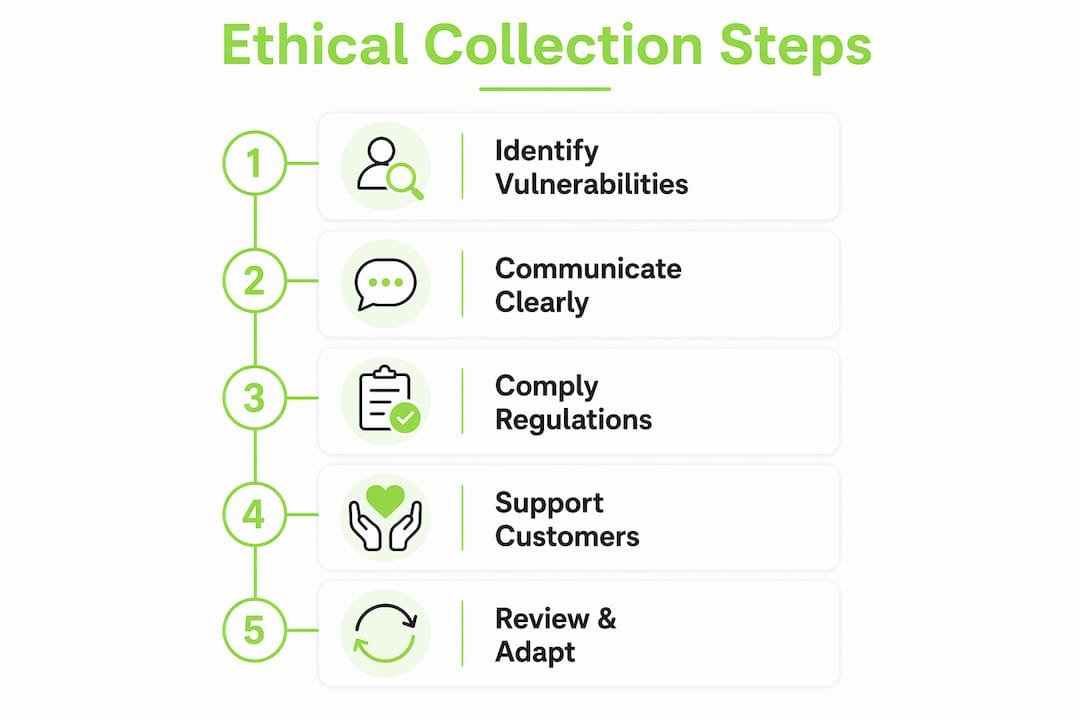
- Initial contact and account verification
- Offer of repayment plan and income-and-expenditure assessment
- Vulnerability check and signposting to debt advice if indicated
- Suspend recovery if plan is under development
- If no engagement after documented attempts: senior manager review
- Legal review and pre-action protocol compliance check
- Court action or enforcement agent instruction, with proportionality assessment
Legal caveat: Court action and the use of enforcement agents must comply with the relevant pre-action protocol for the debt type. Where a customer is subject to an insolvency order or a breathing space moratorium under the Debt Respite Scheme, enforcement must stop. Threatening court action as a tactic, rather than a genuine next step, breaches CONC 7.3 and may constitute an unfair practice under the Consumer Duty.
This article is general information, not legal advice. Confirm current rules with the FCA Handbook or a qualified legal professional for your specific situation.
How Debt Recovery Hub helps operationalise ethical collections
Finding a collection agency that genuinely meets CONC and Consumer Duty standards is harder than it sounds. Most procurement processes rely on word of mouth or a Google search, which gives you no documented basis for the selection decision.
Debt recovery hub takes a different approach. The platform gathers detailed case information upfront: debt type, amount, age, and location. That intake process produces a documented record of the selection criteria, which matters when a regulator asks how you chose your third-party agent.
What the platform does in practice:
- Captures comprehensive case details before any agency is contacted
- Matches the case to vetted partner agencies based on specialism, geography, and debt profile
- Provides a documented chain of selection that supports third-party governance evidence
- Covers business debt, property-related debts, and specialist or international cases
Benefits for compliance teams:
- Faster access to appropriate partners without informal procurement
- Reduced risk of selecting an agency that does not meet CONC standards
- A documented audit trail that demonstrates due diligence to regulators
- Support for the FCA’s expectation that firms take reasonable steps to ensure outsourced agents comply with CONC
Using a vetted partner network through Debt Recovery Hub also reduces the operational burden of managing multiple agency relationships independently, freeing compliance and operations teams to focus on policy and oversight rather than procurement.
Key takeaways
Ethical debt collection in the UK requires firms to combine FCA CONC compliance, Consumer Duty obligations, and documented operational controls into a single, board-approved policy that is tested, trained, and audited regularly.
| Point | Details |
|---|---|
| Pause recovery immediately | Suspend active pursuit as soon as a customer signals engagement or is developing a repayment plan. |
| Document vulnerability consistently | Record source, impact, adjustments, and referral details in your CRM for every identified case. |
| Publish a board-approved policy | Name a policy owner, set a review date, and include CONC and Consumer Duty references explicitly. |
| Audit and train continuously | Run quarterly case sampling, annual competency assessments, and roleplay exercises for all agents. |
| Use Debt Recovery Hub for vetted partners | The platform matches cases to compliant agencies and provides a documented selection audit trail. |
Why ethical collections are a business decision, not just a compliance one
The framing of ethical debt collection as a regulatory burden misses the point. Firms that treat customers fairly during financial difficulty tend to recover more, not less. A customer who trusts the process is more likely to engage, more likely to maintain a repayment plan, and far less likely to escalate to a formal complaint or seek legal advice. The regulatory cost of a complaint upheld by the Financial Ombudsman Service is significant; the reputational cost of a pattern of complaints is worse.
There is also a governance argument. The Consumer Duty has shifted the FCA’s supervisory lens from rule-following to outcome-delivery. A firm that can demonstrate, through training records, audit logs, and documented vulnerability checks, that it consistently delivers good outcomes for customers in arrears is in a fundamentally stronger position than one that relies on a policy document nobody reads.
At Debt Recovery Hub, the commitment to responsible debt collection practices shapes how partner agencies are vetted and how cases are matched. The goal is not just a successful recovery — it is a recovery that neither party needs to revisit.
Start recovering debt through a vetted, compliant partner
Selecting the right collection agency is one of the most consequential compliance decisions a business makes, and most organisations make it without a documented process. Debt Recovery Hub removes that gap. Submit your case details through the debt recovery quote form and the platform matches your case to a vetted agency based on debt type, amount, age, and location, giving you a documented selection record from day one.

Every partner agency in the network is assessed against compliance standards before any referral is made. For businesses that need to demonstrate third-party governance to the FCA, that documented vetting process is a concrete piece of evidence. Visit the debt collection services page to see how the matching process works and submit your case details to get started.
Useful sources and further reading
FCA Handbook — primary regulatory sources:
- CONC 7.3: Treatment of customers in or approaching arrears or default — forbearance, suspension of recovery, referral to debt advice
- CONC 7.5: Disputed debt handling — investigation obligations, identity verification, assignment notification
- CONC 7.14: Settlements, disputed and deadlocked debt — written explanation when rejecting a repayment proposal
- CONC 2.6: Conduct of business — debt counselling and related services — premium-rate number restrictions
- CONC 1.2.2 R: Firm responsibilities for agents — third-party governance obligations
Industry guidance:
- CSA Code of Practice and Common Principles — member standards for vulnerability identification and governance
Free debt advice and guidance:
- MoneyHelper: moneyhelper.org.uk — free, impartial money guidance and debt advice signposting
- Money and Pensions Service: moneyandpensionsservice.org.uk
Debt Recovery Hub resources:
- Debt collection services overview
- Services and specialisms
- Debt recovery quote form
- Insights and sector commentary
FAQ
What is ethical debt collection?
Ethical debt collection is the recovery of outstanding debts through fair, proportionate methods that comply with FCA CONC and the Consumer Duty, including offering affordable repayment options, identifying vulnerable customers, and suspending recovery while a repayment plan is being developed.
Can a debt be pursued after many years?
In England and Wales, most unsecured debts become statute-barred after six years under the Limitation Act, meaning a creditor cannot pursue court action after that period. The clock typically runs from the last payment or written acknowledgement of the debt.
What should a firm do when a customer disputes a debt?
Under CONC 7.5.5 R, the firm must investigate the dispute promptly and must not continue demanding payment without providing a clear, written basis for rejecting it. Recovery activity should pause during the investigation.
What is the “7-7 rule” in debt collections?
The 7-7 rule is a US collections industry guideline, not a UK regulatory requirement. UK firms are governed by FCA CONC, which does not prescribe a fixed contact frequency but prohibits excessive or oppressive contact and requires all communication to be for a reasonable purpose.
How do you collect debt ethically when a customer is vulnerable?
Pause active recovery, record the vulnerability in your CRM with the source, impact, and agreed adjustments, offer alternative contact channels and forbearance options, and refer the customer to free debt advice through MoneyHelper or a not-for-profit debt advice body, as required under CONC 7.3.