



A letter before action (LBA) is a formal written notice sent to another party before you start court proceedings, telling them what you claim, how much you want, and what happens if they ignore you. Under the Civil Procedure Rules, courts in England and Wales expect claimants to send a compliant pre-action letter before issuing a claim. Skip it, and you risk costs penalties even if you win.
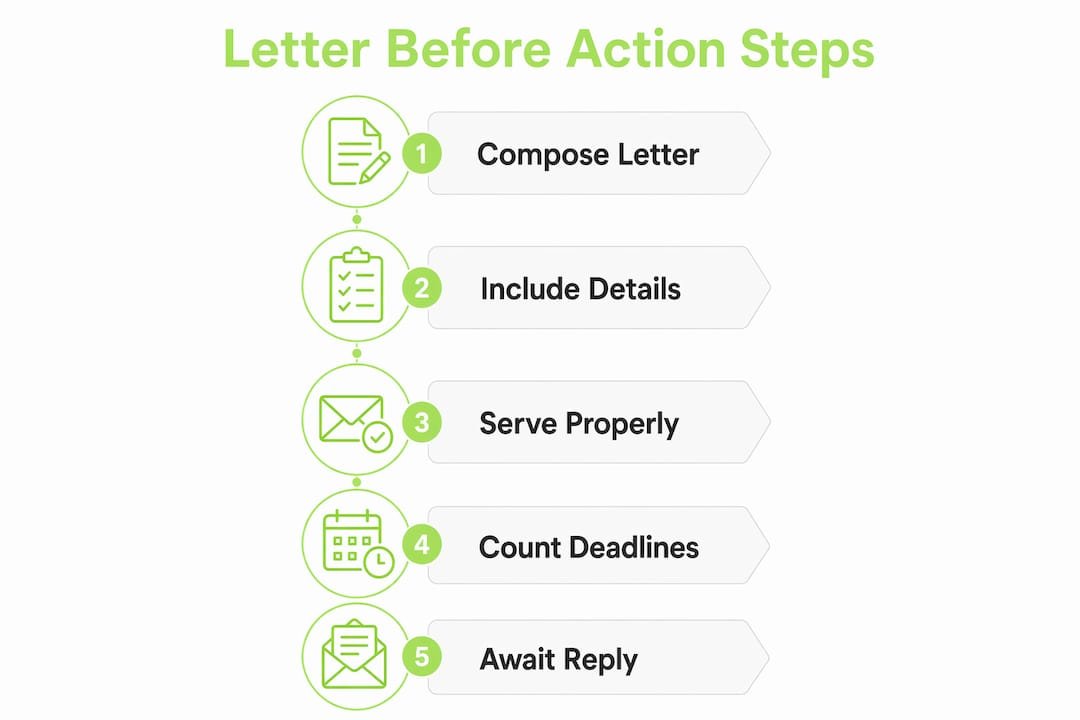
Before you send anything, run through this checklist:
- Gather your evidence: invoices, contracts, correspondence, photographs, receipts.
- Identify which pre-action protocol applies: debt claims, consumer goods, professional negligence, or the general Practice Direction.
- Set the correct deadline in clear days: 30 clear days for business-to-individual debt claims under the Debt Pre-Action Protocol; 14 days is commonly reasonable for straightforward cases without a specific protocol.
- Choose a service method that gives you proof of delivery, such as recorded post or email with retained headers.
- Keep a service log and copies of everything you send.
The single most important thing to get right is the deadline calculation. Courts count “clear days,” meaning the day of service does not count. Serve on 1 April, and 30 clear days ends on 1 May. State that calculation visibly in the letter itself.
Table of Contents
- Why a letter before action matters under the Civil Procedure Rules
- What your letter before action must include
- Practical templates for debt, faulty goods, and breach of contract
- How to serve the letter and count the deadline correctly
- What to do when the deadline passes (or when they reply)
- Costs, sanctions, and the risks of getting it wrong
- When to hire a solicitor or use a debt collection agency
- Key takeaways
- The case for proportionate, evidence-led pre-action letters
- Already sent the letter? Here is what Debt recovery hub can do next
- Useful sources and further reading
- FAQ
Why a letter before action matters under the Civil Procedure Rules
The Practice Direction on Pre-Action Conduct and Protocols sits at the heart of civil litigation in England and Wales. Its purpose is straightforward: courts want parties to try to resolve disputes before a judge gets involved. The Practice Direction requires claimants to set out the basis of the claim, a summary of facts, the remedy sought, and, where money is claimed, how the amount is calculated.
Several specific pre-action protocols exist for common dispute types: the Debt Claims Protocol, the Personal Injury Protocol, the Professional Negligence Protocol, and the Construction and Engineering Protocol, among others. Where no specific protocol applies, the general Practice Direction governs. The proportionality principle runs through all of them. A letter demanding £800 for an unpaid invoice should not read like a High Court pleading.
Courts may take into account the conduct of the parties during the pre-action period when deciding costs. A claimant who sends an aggressive, disproportionate, or non-compliant letter before action risks a costs sanction even if the substantive claim succeeds. The Practice Direction is explicit: tactical or bullying use of pre-action correspondence is conduct the court can and does penalise.
The consequences of skipping a pre-action letter are real. A judge can stay proceedings, order the claimant to pay the defendant’s costs, or make an adverse costs direction at the end of the case. None of those outcomes are hypothetical; they appear regularly in county court costs decisions.
Pro Tip: Keep the tone of your letter factual and businesslike. Avoid ultimatums, capital letters, and phrases like “we will pursue all available legal remedies” stacked three times in one paragraph. One clear statement of consequences is enough and far more effective.
What your letter before action must include
The Practice Direction sets out the minimum contents. A compliant letter before action must state the basis of the claim, a summary of relevant facts and evidence, the exact amount or remedy sought, and a clear warning that proceedings may follow if the matter remains unresolved after the deadline.
Clause-by-clause checklist:
- Heading and label. Use “Letter Before Action” or “Letter of Claim” at the top. Include the full names and addresses of both parties, and the date.
- Factual summary. Set out the facts in chronological order. Keep it concise: what happened, when, and why the other party is liable.
- Legal basis. Name the legal ground: breach of contract, unpaid invoice, faulty goods under the Consumer Rights Act 2015, negligence, and so on.
- Remedy sought. State the exact sum claimed, broken down clearly (principal, interest, any fees). If you want repair, replacement, or specific performance rather than money, say so precisely.
- Supporting documents. List the documents you are relying on and attach copies where the protocol requires it. Do not over-attach; include only what is reasonably necessary.
- ADR offer. The Practice Direction expects parties to consider alternative dispute resolution. A brief line offering mediation or negotiation demonstrates good faith and protects your costs position.
- Deadline in clear days. State the date of service, the start date (day after service), and the deadline date. Example: “This letter is served on 1 April 2026. You have 30 clear days from 2 April 2026 to respond, meaning the deadline is 1 May 2026.”
- Consequences of non-response. State plainly that if no reply is received by the deadline, you intend to issue proceedings without further notice and may seek costs.
- Reply instructions. For debt claims, include the required reply form and information sheet. State where the reply should be sent.
Before you post or email, proof-check against this list:
- Both parties’ full names and addresses are correct.
- The legal basis is named, not just implied.
- The sum is broken down and the calculation is shown.
- The clear-day deadline is calculated and stated explicitly.
- The ADR offer is included.
- The reply form and information sheet are attached (debt protocol claims).
- You have kept a copy of the complete letter and all attachments.
Practical templates for debt, faulty goods, and breach of contract
Templates are a starting point. Tailoring the letter to reference the exact contract number, invoice references, and supporting documents materially reduces the other side’s ability to claim ignorance, and strengthens your position if the matter proceeds to court.
Template 1: Unpaid invoice (debt claim)
Letter Before Action
[Your name and address]
[Date][Recipient’s full name and address]
Dear [Name],
I write regarding invoice number [XXXX] dated [date], for [description of goods/services], in the sum of £[amount], which remains unpaid despite my request of [date of chaser].
The legal basis for this claim is breach of contract. I attach a copy of the invoice and our written agreement dated [date].
I require payment of £[amount] (plus interest at [rate]% from [date] to the date of payment, currently £[X]) by [deadline date, being 30 clear days from the date of service].
If I do not receive payment or a completed reply form by that date, I intend to issue proceedings in the county court without further notice. You may be liable for court fees and costs in addition to the sum claimed.
I am willing to discuss a payment arrangement or mediation if you contact me before the deadline.
Please complete the enclosed reply form and return it to the address above.
Yours sincerely,
[Your name]
Template 2: Faulty goods (consumer complaint)
Letter of Claim
[Your name and address]
[Date][Retailer/supplier name and address]
Dear [Name],
I purchased [description of goods] from you on [date] for £[amount] (receipt enclosed). The goods are faulty: [brief factual description of the fault and when it appeared].
Under the Consumer Rights Act 2015, I am entitled to a [refund / repair / replacement]. I request [chosen remedy] within 14 days of the date of this letter.
If I do not receive a satisfactory response by [deadline date], I intend to pursue this matter through the county court and/or relevant alternative dispute resolution scheme without further notice.
Yours sincerely,
[Your name]
Template 3: Breach of contract (commercial)
Letter Before Action
[Your company name and address]
[Date][Recipient company name and address]
Dear [Name],
We refer to the contract between us dated [date] (reference [XXXX]). You were required to [describe obligation] by [date]. You have failed to do so, constituting a breach of contract.
As a result, we have suffered loss of £[amount], calculated as follows: [brief breakdown].
We require you to remedy the breach / pay the sum of £[amount] within [14/30] clear days of the date of this letter, being by [deadline date].
If no satisfactory response is received by that date, we will issue proceedings without further notice and will seek our legal costs.
We are open to resolving this matter through mediation or negotiation.
Yours faithfully,
[Your name / authorised signatory]
Customisation notes:
- Always insert the specific invoice number, contract reference, and dates. Generic letters are easier to dispute.
- Attach only the documents the protocol requires or that directly support your claim. Over-attaching can look tactical and attract criticism.
- Show the clear-day calculation in the body of the letter, not just in a covering note.
How to serve the letter and count the deadline correctly
Getting service right matters. A letter that cannot be proved to have arrived gives the other side an easy argument that the deadline never started running.
Acceptable service methods:
- Recorded delivery post. Retain the Royal Mail tracking receipt and print the delivery confirmation. This is the most straightforward method for most claims.
- Email. Send to the other party’s known business or personal email address. Retain the sent-item header showing the recipient address, timestamp, and any read receipt. Follow up with a hard copy if the sum is significant.
- Personal service. Rarely necessary for pre-action letters, but appropriate where you have reason to doubt the other party will collect post or check email.
Clear-day calculation table:
| Date served | Clear days required | Deadline |
|---|---|---|
| 1 April | 14 | 15 April |
| 1 April | 30 | 1 May |
| — | 14 | — |
| — | 30 | — |

Under the Debt Pre-Action Protocol, creditors claiming debts from individuals must give 30 clear days to respond and include a reply form and information sheet. For other claims without a specific protocol, 14 days is commonly considered reasonable for straightforward cases, with longer periods possible in complex matters.
What to record in your service log:
- Date and method of service.
- The email address or postal address used.
- A list of all attachments sent.
- The tracking reference or email timestamp.
- The calculated deadline date.
Pro Tip: When in doubt, use the longer timeframe. Stating 30 clear days where 14 might have sufficed costs you nothing and demonstrates good faith. Show the calculation in the letter so there is no dispute about when the clock started.
What to do when the deadline passes (or when they reply)
How you respond to a reply, or the absence of one, shapes your costs position and your prospects in court.
If the other side replies:
- Full admission. Agree a payment date or plan in writing. If they pay, the matter is resolved. Keep the correspondence.
- Partial admission. Decide whether the admitted sum is acceptable. If not, reply identifying the remaining dispute and consider whether mediation would narrow the issues before proceedings.
- Dispute or denial. Read the response carefully. If they raise a genuine defence, consider whether your evidence is sufficient. Seek legal advice if the dispute is complex.
- Counterclaim. Take this seriously. A counterclaim can exceed your original claim. Get advice before responding.
- Request for more information or documents. Respond promptly and proportionately. Refusing a reasonable request can count against you on costs.
If no response arrives by the deadline:
- Send a short reminder by the same service method, noting the original deadline has passed and that you intend to issue proceedings.
- Confirm your service evidence is complete and accessible.
- Prepare your claim form (N1 for county court money claims) and supporting documents.
- Retain the original LBA and proof of service. The court will expect to see them.
One critical warning: sending a letter before action does not pause limitation periods. The Limitation Act 1980 continues to run. If your limitation deadline is within weeks, issue proceedings promptly rather than waiting for the LBA response period to expire. Seek legal advice if you are unsure.
Decision flow: negotiate, mediate, or issue?
- Partial admission or genuine dispute → consider mediation first.
- Full denial with no credible defence → prepare proceedings.
- No response at all → confirm service, send reminder, then issue.
- Limitation close → issue proceedings without delay.
Costs, sanctions, and the risks of getting it wrong
The Practice Direction is explicit: courts take pre-action conduct into account when deciding costs. That cuts both ways. A defendant who ignores a compliant LBA faces an adverse costs order. A claimant who sends an aggressive, non-compliant letter risks the same.
Conduct that courts disapprove of:
- Inflammatory language or exaggerated threats.
- Attaching large volumes of documents to impose cost on the other side.
- Making false or misleading statements of fact.
- Refusing a reasonable request for more time or information.
- Ignoring an ADR offer without good reason.
Typical costs drivers in a disputed claim include solicitor drafting fees, court issue fees (scaled to the value of the claim), and enforcement costs after judgment. None of these are trivial, and a costs sanction on top of them can turn a winning claim into a net loss.
Avoid inflammatory language or exaggerated threats. Courts may regard such language as harassment and can impose costs sanctions. Keep the letter professional, factual, and limited to what the protocol requires.
The proportionality principle is the practical test. Ask yourself: would a reasonable person reading this letter think it was designed to resolve a dispute, or to intimidate? If the answer is the latter, rewrite it.
To reduce your costs risk:
- Use plain, factual language throughout.
- Attach only the documents the protocol requires.
- Offer ADR genuinely, not as a formality.
- Give the correct protocol deadline, not an artificially short one.
- Do not threaten consequences you are not prepared to follow through on.
When to hire a solicitor or use a debt collection agency
Most straightforward unpaid invoice claims can be handled with a well-drafted LBA and, if needed, a county court money claim. But some situations genuinely warrant professional help, and misjudging that line is expensive.
Situations that usually warrant a solicitor:
- The claim exceeds the small claims track limit and is likely to be defended.
- The dispute involves allegations of fraud, misrepresentation, or professional negligence.
- There is a cross-jurisdictional element (the debtor is based outside England and Wales).
- Limitation is close and you need urgent advice on whether to issue.
- The other side has legal representation and you do not.
Solicitor vs. debt collection agency:
A solicitor provides legal advice, can represent you in court, and carries professional indemnity insurance. Their involvement adds credibility to an LBA, particularly for high-value or complex claims. A debt collection agency focuses on practical recovery: chasing, negotiating payment plans, and supporting enforcement after judgment. For straightforward unpaid invoices, a correctly drafted LBA followed by an agency referral often achieves faster recovery at lower cost than litigation.
Questions to ask any provider:
- What are your fees? Fixed fee for drafting, or contingency/commission on recovery?
- What enforcement options can you pursue after judgment (warrant of control, attachment of earnings, charging order)?
- What is your typical timeline from instruction to first contact with the debtor?
- How do you report progress, and how often?
- What happens if the debtor disputes the claim?
Typical charging models: solicitors often charge a fixed fee (ranging from a few hundred to over a thousand pounds depending on complexity) for drafting and reviewing an LBA. Debt collection agencies typically work on a commission basis, taking a percentage of the recovered sum. Neither model is universally better; it depends on the value of the debt and the likelihood of a dispute.
Pro Tip: For complex claims or where costs consequences may be significant, get a solicitor to review the letter before it goes out. For a straightforward unpaid invoice under £10,000, a well-drafted LBA plus a specialist debt collection partner will often get you paid faster and more cheaply than court.
Key takeaways
A compliant letter before action, served with proof of delivery and the correct clear-day deadline, is the single most effective step you can take to recover a debt or resolve a dispute before court.
| Point | Details |
|---|---|
| Use the correct protocol | Debt claims against individuals need 30 clear days and a reply form; other claims typically allow 14 days. |
| Show the deadline calculation | State the service date, start date, and deadline in the letter to prevent timing disputes. |
| Keep proof of service | Retain tracking receipts or email headers; the court will expect evidence of compliant service. |
| Limitation keeps running | An LBA does not pause the Limitation Act 1980; issue proceedings promptly if limitation is close. |
| Debt Recovery Hub matches cases | For unpaid debts, Debt Recovery Hub connects you with vetted collection agencies suited to your debt type, amount, and location. |
The case for proportionate, evidence-led pre-action letters
Most people who send a letter before action want one of two things: their money back, or the dispute resolved without a court date. The letter is the tool that makes both outcomes more likely, but only if it is written to achieve them rather than to vent frustration.
The conventional wisdom is that a firm, even aggressive, letter signals strength. In practice, the opposite is often true. A letter that reads as a threat rather than a notice gives the recipient a reason to dig in. It also gives a judge a reason to look unfavourably at your costs position later. The letters that actually get paid are the ones that make ignoring them feel more costly than responding.
That means three things in practice. First, the facts should be undeniable: invoice number, date, amount, what was agreed, what was not delivered. Second, the consequences should be stated once, clearly, without embellishment. Third, the offer of resolution (a payment plan, mediation, a call) should be genuine. A debtor who believes there is a way out that does not involve a county court judgment is more likely to take it.
The real value of a well-drafted pre-action letter is that it forces the other side to articulate their position. If they reply with a credible dispute, you learn something useful before you spend money on proceedings. If they fail to reply at all, that silence strengthens your case and your costs position when you do issue. Either way, the letter does work that no amount of chasing phone calls can replicate.
Already sent the letter? Here is what Debt Recovery Hub can do next
If you have sent your pre-action letter and the deadline has passed without payment, the next step is enforcement, and that is where having the right partner matters.

Debt Recovery Hub matches individuals and businesses with vetted debt collection agencies based on the specific details of the case: the debt type, the amount, how old the debt is, and where the debtor is located. There is no guesswork about which agency handles your type of claim. The platform gathers the key details upfront, identifies the agencies best placed to recover the debt, and makes the introduction. From there, the agency takes on the recovery steps, including negotiation, formal demand, and enforcement support after judgment.
The process suits businesses chasing unpaid invoices, landlords recovering arrears, and sole traders dealing with non-paying clients. To get started, submit your case details and Debt Recovery Hub will match you with a suitable agency. Your information is handled confidentially and used only to identify the right recovery partner for your situation.
Useful sources and further reading
The sources below are the authoritative references for pre-action conduct in England and Wales. When checking legal requirements or looking for official templates, start with the primary sources.
Primary and official sources:
- Practice Direction on Pre-Action Conduct and Protocols (Ministry of Justice / Civil Procedure Rules) — the governing document for pre-action conduct in England and Wales.
- Pre-Action Protocol for Debt Claims (Ministry of Justice) — the specific protocol for creditors claiming debts from individuals, including the reply form and information sheet requirements.
- Civil Procedure Rules — Part 44: General Rules About Costs — the costs framework courts apply when assessing pre-action conduct.
- National Debtline: Pre-Action Protocol in the County Court — plain-English explanation of the debt protocol, including the reply form process.
Reputable legal commentary and template guidance:
- eLitigant: Letter Before Claim — the Pre-Action Letter Explained — practical guide covering clear-day counting, limitation warnings, and next steps.
- Qredible: Letter Before Action UK — Template and Guide — template drafting advice with notes on customisation and solicitor review.
Choosing which sources to rely on: always check the primary official sources first (justice.gov.uk and the specific protocol PDFs). Legal commentary and template guides are useful for practical drafting but should not be treated as a substitute for the governing rules themselves.
FAQ
What is a letter before action in England and Wales?
A letter before action is a formal pre-action letter sent before starting court proceedings, setting out the claim, the remedy sought, and a deadline for response. Courts in England and Wales expect one to be sent before a claim is issued, and failure to do so can result in costs penalties.
How many days must I give the other side to respond?
Under the Debt Pre-Action Protocol, a creditor must give an individual debtor 30 clear days to respond. For other claims without a specific protocol, 14 clear days is commonly considered reasonable in straightforward cases.
Does sending a letter before action stop the limitation period?
No. Sending a pre-action letter does not pause the Limitation Act 1980. If your limitation deadline is approaching, issue proceedings promptly rather than waiting for the response period to expire.
What happens if the other side ignores the letter?
If no response is received by the deadline, you may issue proceedings in the county court and rely on the letter and proof of service to support your compliance and costs position. Enforcement options after judgment include a warrant of control, attachment of earnings, and charging orders.
Can Debt Recovery Hub help if the letter before action has not worked?
Yes. If the pre-action stage has not produced payment, Debt Recovery Hub matches your case with a vetted debt collection agency based on the debt type, amount, age, and location, so recovery efforts can continue without you managing the process directly.
This article provides general information about pre-action letters in England and Wales and does not constitute legal advice. For your specific situation, confirm the current rules with the relevant official sources or consult a qualified solicitor.