



TL;DR:
- The Pre-Action Protocol for Debt Claims requires strict adherence to proper documentation, timelines, and communication.
- Following these steps from the start protects creditors against cost penalties and procedural weaknesses in court.
The Pre-Action Protocol for Debt Claims applies when a business (including sole traders or public body) seeks payment from an individual or sole trader — and it sets out exactly what you must do before starting court proceedings. National Debtline, Business Debtline, and Debt Recovery Hub all stress the same point: follow the protocol correctly from the start, or risk cost penalties and enforcement setbacks later.
Your immediate must-do items:
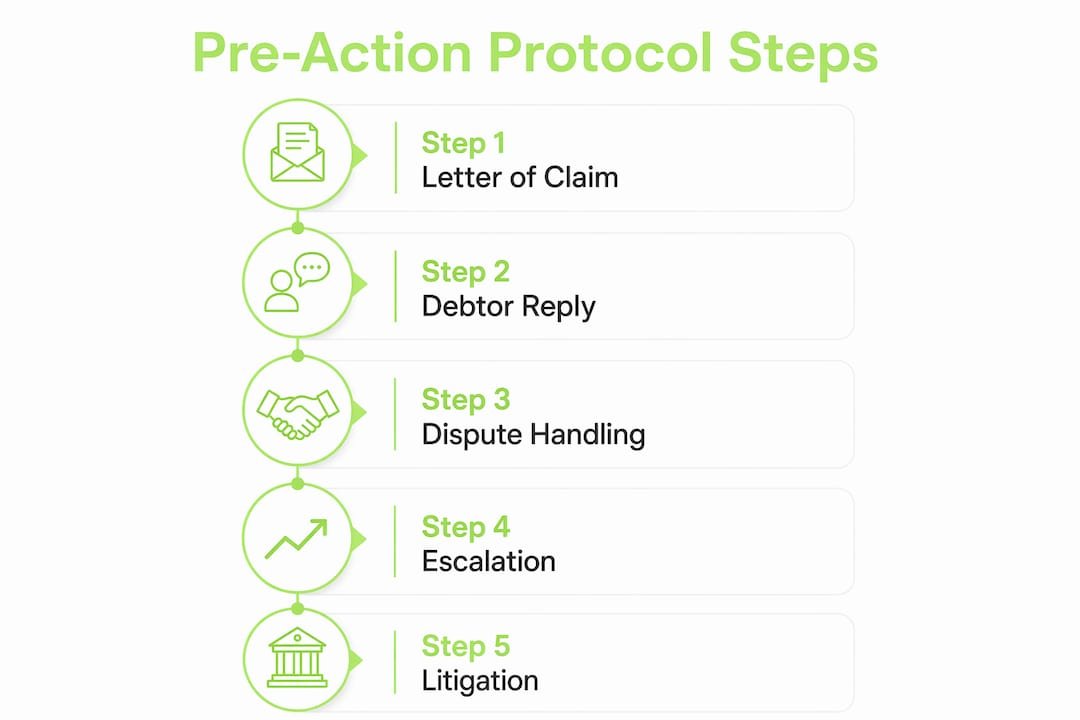
- Send a compliant Letter of Claim including an up-to-date statement of account, the Information Sheet, and the Reply Form (Annex 1).
- Give the debtor 30 days to respond before issuing proceedings.
- If the debtor requests documents, provide them within 30 days or explain why they are unavailable.
- Keep timestamped records of everything sent, including proof of delivery.
Table of Contents
- What does the pre-action protocol for debt actually require?
- When should you escalate to a collection agency or court?
- How does a compliant UK debt collection agency manage the protocol?
- How do you choose a compliant UK debt collection agency?
- What is a statutory demand, and when can it be set aside?
- How does Debt recovery hub support creditors through the process?
- Key takeaways
- Why compliance-first debt recovery actually works
- Ready to find a PAP-compliant debt collection agency?
- FAQ
What does the pre-action protocol for debt actually require?
The protocol is specific about paperwork. Your Letter of Claim must state the debt amount, whether interest is accruing, and the basis of the claim. Alongside it, you must send the Information Sheet and the Reply Form (Annex 1). Where repayment capacity is in dispute, a Financial Statement (Annex 2) is also appropriate.
Timelines matter just as much as documents. The debtor has 30 days to reply. If they indicate on the Reply Form that they are seeking debt advice, you must allow a reasonable period for that advice before issuing proceedings — courts can penalise creditors who do not wait. If the debtor requests specific documents, you have 30 days to supply them.
The court’s broader expectation is early, transparent disclosure. As National Debtline notes, poor transparency can be used against a creditor in later cost assessments. Document when you sent everything and how.
Pro Tip: Attach a simple checklist to your file: statement of account, interest calculation, copy of the original contract or agreement, and the Information Sheet with Reply Form. Send by recorded post or email with read receipt, and save the delivery confirmation. A debtor who later claims they never received the letter of claim will struggle to make that argument stick.
- Draft the Letter of Claim using the protocol’s required headings.
- Attach the Information Sheet, Reply Form, and statement of account.
- Send by a traceable method and log the date.
- Diarise the 30-day reply deadline and any document-request deadlines.
- Record the debtor’s response (or non-response) in writing.
When should you escalate to a collection agency or court?
Escalate when the debtor fails to reply within the protocol timeframe, refuses reasonable repayment proposals, or when the debt is undisputed and commercial urgency is pressing. Those are the clearest triggers.
Scenarios that justify moving forward:
- No reply received after 30 days plus any reasonable extension you have granted.
- Documents returned or undeliverable, suggesting the debtor has moved without notice.
- The debtor explicitly states they will not pay or engage.
- There is a credible risk of asset dissipation.
Some situations demand patience rather than speed. If the debtor has indicated they are seeking advice, or if there is a genuine dispute or arguable defence, pressing ahead risks a costs sanction. A debtor with a credible counterclaim may also apply to set aside any subsequent statutory demand, which creates additional delay and expense.
When you do escalate, preserve every piece of protocol evidence first. Consider a vetted collection agency for pre-litigation recovery. If insolvency-level steps are on the table, get specialist legal advice before proceeding.

How does a compliant UK debt collection agency manage the protocol?
Compliant agencies document pre-action steps, issue PAP-aware letters, and maintain auditable records that protect your position if the matter reaches court. That is the baseline — anything less is a liability.
The process a well-run agency follows:
- Intake and verification: confirm debt amount, debtor identity, and whether the protocol applies (individual or sole trader, not a limited company).
- Evidence collation: gather the statement of account, contract, and any prior correspondence.
- Letter of claim: draft or review a compliant letter, attach the required forms, and send by a traceable method.
- Managed correspondence: handle replies, negotiate repayment plans, and record all communications.
- Escalation: recommend litigation or insolvency steps when the evidence and protocol compliance record support it.
| Process stage | What the agency delivers to you |
|---|---|
| Intake | Verified debt summary and scope confirmation |
| Documentation | Compliant Letter of Claim with all required annexes |
| Correspondence | Timestamped records of all debtor contact |
| Compliance check | Confirmation that reply and advice periods have been observed |
| Escalation trigger | Written recommendation with protocol compliance evidence |
As the protocol guidance makes clear, agencies that bridge pre-action and litigation by documenting PAP compliance reduce the risk of procedural criticism in court.
How do you choose a compliant UK debt collection agency?
Choose agencies that can demonstrate PAP awareness, transparent fees, data-protection measures, and a clear complaints process. Ask for evidence, not assurances.
Checklist when vetting an agency:
- Written templates showing protocol-compliant letters and timelines.
- Membership of a recognised trade body such as the Credit Services Association, or adherence to a published code of practice.
- Transparent, written fee structure with no hidden charges.
- Registration under UK data-protection law and documented data-security procedures.
- Access to lawyer or debt-specialist oversight for escalation decisions.
- A sample engagement letter and a clear complaints procedure.
Red flags to avoid:
- Refusal to show how they document pre-action activity.
- Vague or variable charges with no written terms.
- Aggressive tactics that could expose you to regulatory risk.
- No complaints policy or data-security safeguards.
Questions to ask at first contact:
- How do you handle a debtor who raises a genuine dispute?
- Do you have litigation partners, and how is that handover managed?
- How do you record and evidence PAP compliance for court purposes?
- What happens if the debtor requests debt advice on the Reply Form?
What is a statutory demand, and when can it be set aside?
A Statutory Demand is an insolvency-level step, not a routine collection tool. Treat it as a last resort, not a first move.
If a debtor receives a Statutory Demand and believes the debt is disputed or that a counterclaim exists, they can apply to have it set aside. Under The Insolvency (England and Wales) Rules 2016, that application must be made within 18 days of service. The grounds on which a court may grant a set-aside include:
- A genuine dispute about the debt on substantial grounds.
- A counterclaim, set-off, or cross-demand equal to or exceeding the debt amount.
- Incorrect service or procedural defects in the demand itself.
- The creditor holds security that equals or exceeds the debt.
As Citizens Advice notes, merely needing more time to pay rarely succeeds as a ground for set-aside. But if the creditor has not followed the Pre-Action Protocol, that procedural gap can strengthen a debtor’s challenge. If the demand is set aside, the creditor may face a costs order and must reassess their escalation strategy entirely.
Before issuing a Statutory Demand, obtain specialist legal advice and confirm that all PAP steps are fully documented.
How does Debt Recovery Hub support creditors through the process?
Debt Recovery Hub takes detailed case intake, matches creditors to vetted agencies, and ensures those agencies meet PAP compliance criteria where the protocol applies. The platform removes the guesswork from agency selection.
Matching criteria used:
- Debt type and amount.
- Debtor status (individual, sole trader, or other).
- Debt age and whether the debt is disputed or undisputed.
- Location and case complexity (property-related, cross-border, or insolvency-adjacent).
- Agency compliance credentials and track record.
Benefits to creditors:
- Faster agency matches based on case-specific detail.
- A documented brief passed to agencies, reducing the risk of procedural errors.
- An auditable handover that supports later court action if required.
- Access to specialist case types including property debts and international recovery.
Pro Tip: Before submitting your case, gather your statement of account, the original contract or agreement, any prior correspondence with the debtor, and confirmation of the debtor’s current address. The more complete your intake submission, the faster and more accurate the agency match.
| Matching factor | Why it matters |
|---|---|
| Debtor type | Determines whether the Pre-Action Protocol applies |
| Dispute status | Affects which agency type and approach is appropriate |
| Debt age | Influences recovery likelihood and agency selection |
| Case complexity | Specialist cases need agencies with relevant expertise |
Key takeaways
Following the Pre-Action Protocol correctly from the outset protects your costs position, preserves enforcement options, and gives any subsequent court claim the strongest possible foundation.
| Point | Details |
|---|---|
| Send a compliant letter of claim | Include the Information Sheet, Reply Form, and statement of account before issuing proceedings. |
| Allow the full reply period | Give the debtor 30 days to respond; wait longer if they are seeking debt advice. |
| Document everything | Timestamped records of all correspondence protect you if the matter reaches court. |
| Statutory demands carry real risk | A set-aside application must be made within 18 days of service; get legal advice first. |
| Use Debt Recovery Hub for vetted matches | The platform matches your case to PAP-compliant agencies based on debt type, debtor status, and complexity. |
Why compliance-first debt recovery actually works
Most creditors who run into trouble with debt recovery do so not because they chose the wrong agency, but because they skipped steps they assumed were optional. The Pre-Action Protocol is not a formality — courts treat non-compliance as a substantive issue when awarding costs and interest. A creditor who cannot show they sent the required documents, waited the required periods, and gave the debtor a fair opportunity to respond is handing the other side a procedural argument.
The practical value of a vetted, PAP-aware agency is precisely that it removes this risk. An agency that documents every step, issues compliant correspondence, and knows when to recommend legal escalation is not just collecting a debt — it is building a court-ready file from day one. That distinction matters when a debtor disputes the claim or challenges a statutory demand.
Debt Recovery Hub’s matching model is built around this logic. By capturing case detail upfront and referring only to agencies whose process aligns with the protocol, it reduces the chance of a procedural misstep that could cost more than the debt itself.
Ready to find a PAP-compliant debt collection agency?
Recovering a debt without the right agency behind you is slower and riskier than it needs to be. Debt Recovery Hub matches your case to a vetted, protocol-aware agency based on the specifics — debt amount, debtor type, dispute status, and complexity — so you are not starting from scratch with an agency that may not understand the Pre-Action Protocol’s requirements.

Submit your case details via the debt collection referral form and Debt Recovery Hub will match you to an agency suited to your case type. Have your statement of account, debtor details, and any prior correspondence ready before you start. For complex or urgent cases, the services page sets out the full range of specialist case types the platform handles.
Useful sources
The following official sources underpin this guide and are worth bookmarking for direct reference:
- Pre-Action Protocol for Debt Claims (justice.gov.uk) — the full protocol text, including the Information Sheet, Reply Form (Annex 1), and Financial Statement guidance (Annex 2).
- National Debtline — Pre-Action Protocol guide — plain-English explanation of creditor and debtor obligations, including cost consequences.
- Business Debtline — Pre-Action Protocol guide — focused on sole traders and small businesses; covers timelines and document obligations.
- GOV.UK — Challenge a statutory demand — official guidance on set-aside procedure and consequences for creditors.
- Citizens Advice — Apply to have a statutory demand cancelled — grounds for set-aside and the 18-day application window.
- The Insolvency (England and Wales) Rules 2016, Rules 10.4 and 10.5 — the statutory rules governing set-aside applications, including what the application must contain and the grounds on which a court may grant it.
| Source | Best used for |
|---|---|
| justice.gov.uk protocol PDF | Protocol text, templates, and annexes |
| National Debtline | Cost consequences and compliance overview |
| Business Debtline | Sole trader and small business timelines |
| GOV.UK statutory demand | Set-aside procedure and creditor risk |
| Citizens Advice | Grounds for set-aside and debtor rights |
| Insolvency Rules 2016 | Statutory authority for set-aside applications |
FAQ
Does the Pre-Action Protocol apply to all business debts?
No. The protocol applies only where a business claims payment from an individual or sole trader — it does not apply to standard business-to-business debts between limited companies.
What happens if a creditor ignores the protocol?
Courts can adjust costs and interest to penalise non-compliance, which can significantly reduce the financial benefit of winning a claim.
How long does a debtor have to apply to set aside a statutory demand?
Under the Insolvency (England and Wales) Rules 2016, the debtor must apply within 18 days of service of the statutory demand.
When should I use a debt collection agency rather than going straight to court?
Use an agency when the debtor has not responded within the protocol timeframe, the debt is undisputed, and you want to preserve the option of court action without incurring immediate litigation costs.
How does Debt Recovery Hub match creditors to agencies?
Debt Recovery Hub collects case details — debt type, amount, debtor status, dispute status, and location — and refers the case to a vetted agency whose credentials and process align with the protocol requirements for that specific case type.
This article is general information, not legal advice. Confirm current rules with a qualified solicitor or the relevant primary source before taking action in your own case.