





For most UK businesses, Chaser is the strongest starting point for collections automation, Quadient AR handles dispute-heavy portfolios best, and HighRadius suits enterprise teams that need AI-driven cash application at scale. When software hits its limits, Debt Recovery Hub matches you to a vetted UK collection agency based on your debt type, amount, age, and location.
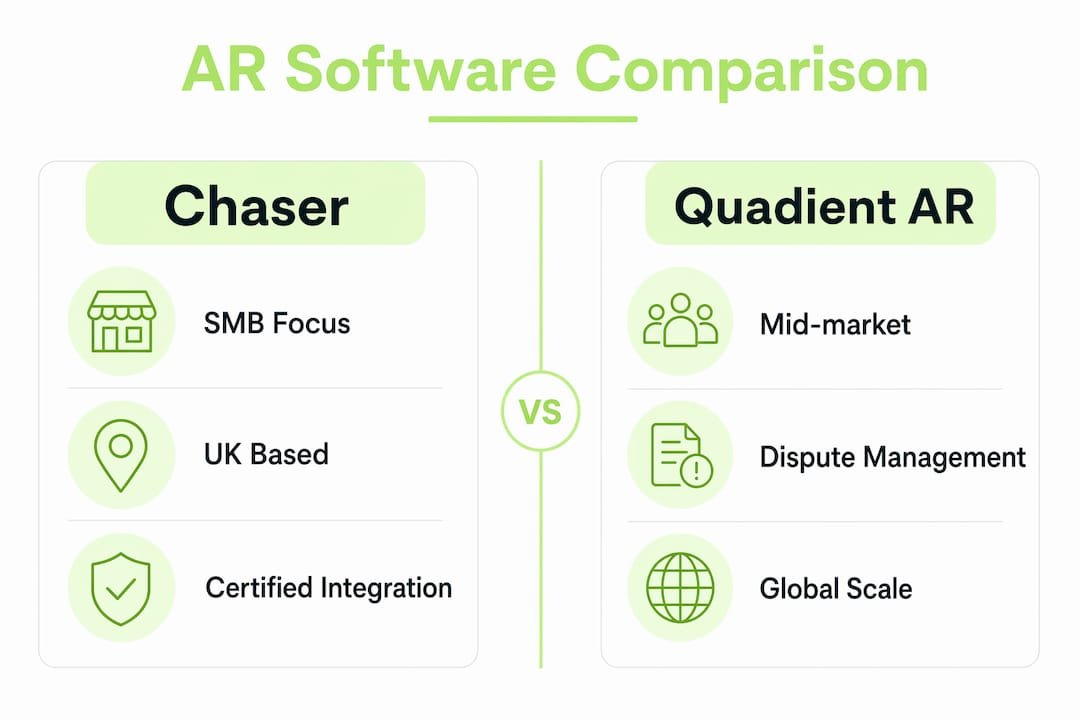
- SMBs with 30+ overdue invoices: Chaser, with its Xero and QuickBooks integration and UK-based support, typically delivers a 15–25% DSO improvement for suitable customers.
- Mid-market with dispute backlogs: Quadient AR, built around collections and dispute management, reduces the manual triage that clogs finance teams.
- Enterprise cash application: HighRadius claims a 10% DSO reduction and 30–40% analyst productivity lift for larger organisations.
- Escalation trigger: When a debt is more than 90 days old, disputed, or above a value your team cannot absorb, hand it to a specialist agency via Debt Recovery Hub rather than running more dunning cycles.
Table of Contents
- How do the best AR software options compare for UK debt recovery?
- Detailed profiles: what each tool actually does
- How to choose the right AR software for your UK business
- When AR software isn’t enough: escalating to a UK collection agency
- When a vetted agency match beats more automation
- Key takeaways
- A practical pilot approach worth considering
- Useful sources and further reading
- FAQ
How do the best AR software options compare for UK debt recovery?
The table below maps the capabilities that actually matter when you are choosing between accounts receivable automation tools. Pricing is indicative; always confirm with the vendor.
| Dimension | Chaser | Quadient AR | HighRadius |
|---|---|---|---|
| Best for | SMB / lower mid-market | Mid-market / enterprise | Enterprise |
| Collections automation depth | Strong dunning workflows, personalised sequences | Deep collections + dispute workflows | AI-agent dunning, predictive prioritisation |
| Cash application accuracy | Basic matching | Moderate | High-accuracy AI matching |
| Dispute management | Limited | Strong | Moderate |
| Native integrations | Xero, QuickBooks, Sage | NetSuite, ERPs | NetSuite, SAP, Oracle |
| Pricing shape | Subscription, published tiers | Quote-based | Quote-based |
| UK availability | UK-headquartered | UK customers, no local office listed | UK customers, global support |
| Implementation time | Days to weeks | Weeks to months | ~5 months for full ERP integration |
Pro Tip: During any demo, ask the vendor to show you a live integration certification badge (Xero App Partner, NetSuite SuiteApp) rather than a logo on a marketing page. Also ask whether cash matching runs on a single-tenant or shared-rule engine — the answer tells you how much the match rate will degrade on your specific invoice formats.
Trust signals worth checking on vendor pages before you commit:
- Published case studies showing a named DSO reduction figure
- A free trial or structured demo with your own data
- Certified integration status (not just a listed connector)
- A documented UK support SLA or named UK contact
Detailed profiles: what each tool actually does
Chaser
Chaser is built for UK SMBs and is one of the few AR platforms headquartered in the UK. Its core product is a dunning workflow engine that sends personalised payment-chase emails and SMS messages on a schedule you control. The customer payment portal is where it earns its keep fastest: a self-service portal commonly cuts inbound “where do I send payment?” queries by 40–60%, which alone frees up significant finance-team time. Chaser holds Xero App Partner status and integrates with QuickBooks, making it a natural fit for the accounting stacks most UK SMBs already run. Pricing is published in tiers, and most businesses are live within days.

Quadient AR
Quadient AR (which absorbed YayPay’s capabilities) is the go-to recommendation when disputes and deductions are the primary bottleneck. Its collections workflow is mature, with configurable escalation paths, dispute-logging, and a collaboration layer that lets sales and finance teams work the same case without emailing spreadsheets back and forth. Dispute management is its clearest differentiator over collections-first tools. It connects to NetSuite and major ERPs, and pricing is quote-based. Implementation typically runs several weeks to a few months depending on ERP complexity.
HighRadius
HighRadius positions itself around AI agents that automate end-to-end AR, with cash application accuracy as the headline capability. For enterprise finance teams processing high invoice volumes across multiple currencies, the AI matching engine reduces the manual exceptions that consume analyst time. Modern AR platforms unify billing, collections, payments and AR accounting into a single ledger, and HighRadius is one of the more complete implementations of that model. Expect a full enterprise rollout to take around five months, including ERP field mapping, test cycles, and exception-handling configuration.
Integration matrix
| Tool | Xero | QuickBooks | NetSuite | SAP / Oracle |
|---|---|---|---|---|
| Chaser | ✓ Certified | ✓ Certified | — | — |
| Quadient AR | — | — | ✓ | Partner |
| HighRadius | — | — | ✓ | ✓ |
How to choose the right AR software for your UK business
Work through this checklist before you sign anything.
- Define your primary pain point. Collections automation, cash application accuracy, and dispute management are distinct product strengths. Match the tool’s core DNA to your biggest problem, not its overall rating.
- Verify integration certification. A logo on a partner page is not the same as a certified connector. Check the Xero App Marketplace or NetSuite SuiteApp directory directly.
- Confirm UK support and SLA. Ask for a named UK contact and a written response-time commitment. Global support desks with no UK hours create real problems at month-end.
- Check GDPR and data residency. Ask where customer data is stored and whether the vendor holds ISO 27001 certification. UK GDPR requires you to know this before processing customer payment data.
- Assess pricing transparency. Quote-only pricing is not a red flag, but opaque per-invoice fees that compound at volume can make enterprise tools far more expensive than the headline suggests.
- Request a trial with your own data. Generic demos hide integration gaps. Insist on connecting your actual Xero or NetSuite instance, even briefly.
- Ask for sector references. A vendor with no UK customers in your sector cannot give you a realistic DSO improvement estimate for your debtor profile.
Red flags: opaque pricing that changes materially after contract signature; no audit trail for accounting entries; cash application described as “manual review with automation assist” (that is just manual); missing UK references.
Pro Tip: Businesses tracking more than 30 past-due invoices in spreadsheets will typically cover software costs within a quarter thanks to typical DSO improvements of 15–25%. Use that as your internal ROI threshold before committing to enterprise spend.
When AR software isn’t enough: escalating to a UK collection agency
Software cannot compel payment. When these signals appear, escalation to a professional agency is the practical next step.
| Signal | Threshold / indicator |
|---|---|
| Debt age | 90+ days past due with no payment plan agreed |
| Debt value | High enough that write-off would materially affect cash flow |
| Dispute status | Disputed and unresolved after two escalation attempts |
| Debtor behaviour | Repeat non-payer or unresponsive to all contact channels |
| Cross-border | Overseas debtor requiring jurisdictional expertise |
Before you hand a case to an agency, consolidate these documents:
- Original signed contract or purchase order
- All invoices and credit notes
- Proof of delivery or service completion
- Full payment history and any partial payments received
- Communications log (emails, letters, call notes)
UK debt collection operates under the Financial Conduct Authority’s consumer credit framework and the Debt Respite Scheme (Breathing Space). Agencies must follow the FCA’s rules on fair treatment and cannot use oppressive tactics. Keep a complete audit trail of your own communications before escalation — gaps in the record weaken the agency’s position.
Pro Tip: Export your AR ageing report and communications log from your software before the handoff. A clean, timestamped record of every contact attempt is the single most useful thing you can give an agency at intake.
When a vetted agency match beats more automation

Some debts are simply beyond what any software can recover. Cross-border receivables, high-value aged debt, legally disputed balances, and property-related arrears all benefit from a specialist agency rather than another dunning sequence.
Debt Recovery Hub matches your case to a vetted UK collection agency based on debt type, amount, age, and location. The intake captures the details that determine which agency has the right specialism and track record for your situation. There is no guesswork and no cold-calling a directory of agencies.
Use cases where a matched agency consistently outperforms more automation:
- Debts over 90 days old where dunning has already failed
- Cross-border recovery requiring international payment expertise
- High-value B2B disputes requiring legal escalation
- Property-related arrears (commercial rent, service charges)
- Cases where the debtor is unresponsive to all digital contact
Submit your case details at Debt Recovery Hub’s debt collection page and receive a matched agency recommendation based on your specific situation.
Key takeaways
The right AR software reduces DSO and frees finance teams from manual chasing, but aged or disputed debt ultimately needs a specialist agency, not more automation.
| Point | Details |
|---|---|
| Match tool to pain point | Choose Chaser for collections automation, Quadient AR for disputes, HighRadius for enterprise cash application. |
| Verify integrations directly | Check Xero App Marketplace or NetSuite SuiteApp directory — not just the vendor’s partner logo page. |
| SMB ROI threshold | Businesses with 30+ overdue invoices in spreadsheets typically recover software costs within a quarter thanks to typical DSO improvements of 15–25%. |
| Escalate at 90 days | Debt over 90 days old, disputed, or cross-border warrants a specialist agency rather than further dunning. |
| Use a matched agency | Debt Recovery Hub connects cases to vetted UK agencies by debt type, amount, age, and location. |
A practical pilot approach worth considering
The most common mistake I see is businesses buying enterprise AR software before they have measured what collections automation alone can deliver. Start smaller: deploy a collections automation tool with a customer payment portal, run it for 60–90 days, and measure three things — inbound payment queries, portal adoption rate, and DSO change. Those three metrics will tell you whether you need to spend more on cash application AI or whether the problem is actually debtor behaviour that software cannot fix.
Set a concrete DSO target before you go live, not after. And brief your sales team before the first dunning email goes out — a chased customer who also has an open upsell conversation needs a human touch, not an automated reminder. Coordinate finance and sales from day one, or you will spend the first month firefighting relationship complaints rather than measuring results.
If DSO does not move within 90 days, the debt is likely too old or too disputed for software to shift. That is the moment to submit to Debt Recovery Hub rather than buying a more expensive tool.
Useful sources and further reading
- Accounts receivable automation overview — Sage’s explanation of core AR capabilities and DSO reduction; a solid starting point for understanding what the software category actually covers.
- HighRadius AR software — vendor page with published claims on DSO improvement and analyst productivity; useful for enterprise evaluation.
- Quadient AR product note — independent summary of Quadient AR’s dispute management heritage and recommended use cases.
- Gaviti SMB review — detailed review covering DSO improvement ranges and portal adoption data for SMB-scale deployments; the figures cited in this article come from this source.
- Debt Recovery Hub debt collection — intake page for matching cases to vetted UK agencies; review the matching criteria before submitting.
- NetSuite AR software — authoritative reference for NetSuite’s native AR capabilities and integration model; relevant if NetSuite is your ERP of record.
Always request vendor case studies and integration certification evidence during demos — published claims on a marketing page carry far less weight than a named customer reference in your sector.
FAQ
What does accounts receivable software actually do?
AR software automates invoicing, payment tracking, dunning sequences and cash application to reduce Days Sales Outstanding and replace manual spreadsheet-based chasing.
Which AR software works best for small UK businesses?
Chaser is the strongest SMB option for UK businesses, with certified Xero and QuickBooks integration, UK-based support, and published pricing — and it typically delivers a 15–25% DSO improvement for suitable customers.
How long does AR software implementation take?
SMB tools like Chaser can be live within days; enterprise platforms with full ERP integration typically take around five months to deploy fully.
When should I escalate to a debt collection agency instead?
Escalate when a debt is 90+ days overdue, disputed and unresolved, cross-border, or high enough in value that further internal chasing is not cost-effective. Debt Recovery Hub matches cases to vetted UK agencies based on debt type, amount, age, and location.
Is my customer data safe with cloud AR software?
Ask vendors for ISO 27001 certification and confirm UK or EU data residency. UK GDPR requires you to know where customer payment data is processed and stored before you sign a contract.