



If you are owed money on a construction project, the single most effective thing you do today is instruct a specialist construction debt recovery firm or, at minimum, begin pre-legal steps before the debt ages further.
Three actions to take right now:
- Secure all supporting documents: contracts, purchase orders, payment notices, certified valuations, and every email or text related to the debt.
- Issue a formal written reminder stating the outstanding sum, the due date, and a seven-day payment deadline.
- Submit your case details to Debt Recovery Hub for a free match to a vetted specialist, or schedule an internal escalation meeting if your credit-control team has capacity.
Read the sections below for the full evidence checklist, fee models, and how to handle retentions and insolvent debtors.
Table of Contents
- What do specialist construction debt recovery firms actually do?
- When should you instruct a specialist rather than handle it in-house?
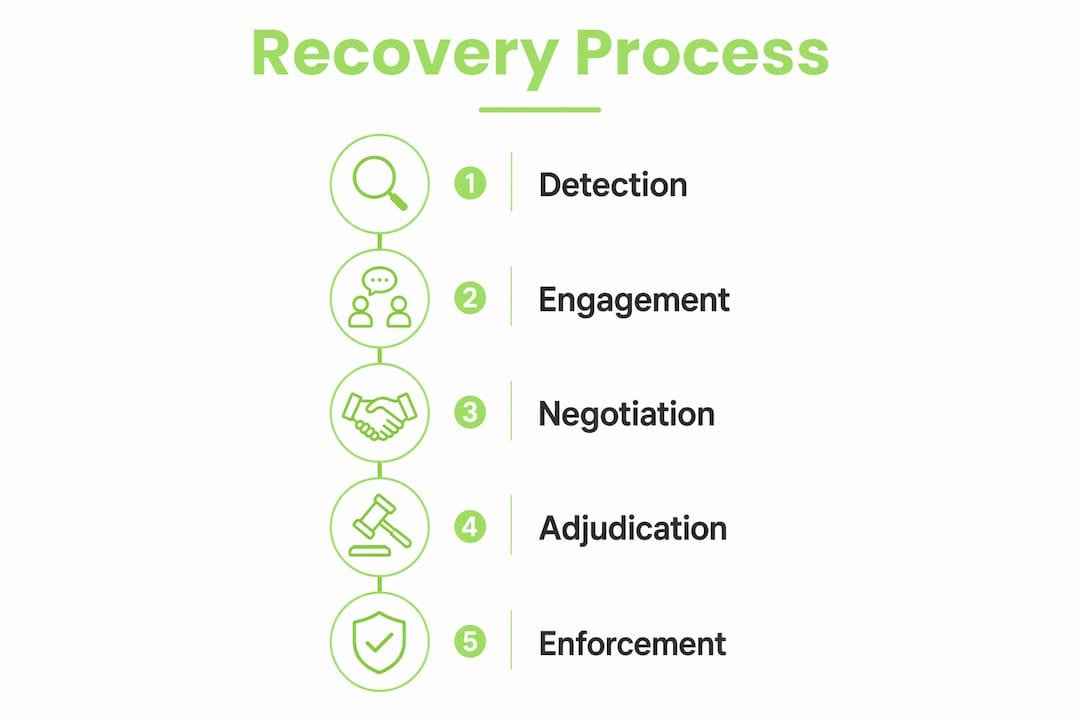
- What does the end-to-end recovery process look like?
- What do construction debt recovery services cost?
- How does retention recovery differ from standard debt collection?
- What can you recover when the debtor is insolvent?
- What documents do you need to support a claim?
- How do you choose the right construction debt recovery partner?
- What trust signals and reporting should you expect from a partner?
- Key takeaways
- The part most contractors get wrong
- Get matched to a vetted construction debt recovery specialist
- Useful sources
- FAQ
What do specialist construction debt recovery firms actually do?
Generalist debt collectors know how to chase a late invoice. Specialists know what a JCT contract says about payment notices, why a retention bond has a notice window, and how to value work in progress when a contractor walks off site. That sector knowledge changes the outcome.
A specialist firm typically handles:
- Credit control and targeted reminders calibrated to construction payment cycles (interim applications, final accounts)
- Retention and retainage recovery, including release notices and bond claims
- Negotiation and adjudication support under the Housing Grants, Construction and Regeneration Act 1996 (the Construction Act)
- Lien and bond claim guidance for bonded projects
- Asset tracing and debtor investigation
- Litigation and enforcement, including County Court Judgments (CCJs), statutory demands and winding-up petitions
- Insolvency liaison, including lodging proofs of debt and engaging administrators
Consider three common scenarios. A main contractor with a disputed final account needs someone who can value the works independently and run an adjudication. A subcontractor chasing a withheld retention needs a firm that understands defects liability periods and bond wording. A materials supplier with a string of recovering unpaid invoices across multiple sites needs systematic credit control and escalation, not a single demand letter. Each scenario calls for a different service mix, and a generalist agency rarely has all three.

When should you instruct a specialist rather than handle it in-house?
Internal credit control works well for straightforward, undisputed debts from solvent debtors. Outside those conditions, the cost of delay usually exceeds the cost of specialist instruction.
Use this checklist to decide:
- Debt age over 60 days with no credible payment commitment
- Disputed debt where the other party contests the valuation, quality, or scope
- Retention involved, especially where the defects liability period has ended
- Debtor showing insolvency signals: county court judgments against them, late filings at Companies House, rumours of administration
- Contract complexity: NEC, JCT, FIDIC, bespoke forms with specific notice requirements
- Bonded or cross-border project where bond claim deadlines or foreign jurisdiction rules apply
- Value above £5,000 where the cost of a specialist is proportionate to the recovery
Early specialist engagement often leads to tactical decisions about completing contracts or pursuing bond claims that maximise net recovery. Waiting until a debt is 120 days old and the debtor is in financial difficulty narrows your options considerably.
Pro Tip: Get specialist advice before you decide whether to complete outstanding works. Completing a contract can sometimes waive your right to claim damages for delay; a specialist can tell you which path preserves more value.
What does the end-to-end recovery process look like?
The recovery timeline is best understood in three phases, each with different tools and escalation choices.
| Phase | Days | Actions | Escalation options |
|---|---|---|---|
| Pre-legal | 0–30 | Payment reminders, formal demand letter, account review | Internal credit control, specialist instruction |
| Dispute resolution | 31–90 | Negotiation, mediation, adjudication (Construction Act) | Adjudicator appointment, mediation referral |
| Legal and enforcement | 90+ | Court proceedings, CCJ, statutory demand, enforcement | Winding-up petition, High Court enforcement, insolvency |
Stage detail:
- 0–30 days: Send a formal letter before action citing the contract, the sum owed, and a 14-day deadline. Use email, post, and where appropriate, SMS, since phone-only outreach is increasingly ineffective and multichannel contact raises engagement.
- 31–90 days: If payment is not forthcoming, adjudication under the Construction Act offers a rapid interim determination, often within 28 days of appointment. It does not guarantee cash in hand, but it creates a payable determination you can enforce or use as leverage. Mediation is non-binding but preserves relationships and costs far less than court.
- 90+ days: County Court proceedings for debts under £100,000, or the High Court for larger sums. A CCJ opens enforcement options: writs of control, charging orders over property, third-party debt orders, and High Court enforcement officers. For debts where the debtor is clearly insolvent, a statutory demand followed by a winding-up petition can prompt payment from a solvent parent or guarantor.
Pro Tip: Keep a contemporaneous communication log from day one: date, time, who you spoke to, what was said, and any payment promise made. This record is often the most persuasive document in an adjudication or court hearing.
What do construction debt recovery services cost?
Fee models vary, and the right one depends on debt value, age, and dispute complexity.
- No-win-no-fee (contingency): The agency takes a percentage of recovered sums only. Contingency-based pricing is common in construction recovery and aligns the agency’s incentive with yours. Rates typically range by debt age and complexity, with older or disputed debts attracting higher percentages.
- Fixed fee: Suits straightforward, undisputed debts where the recovery path is predictable. Gives cost certainty but transfers risk to the creditor if recovery fails.
- Hourly or retainer: Common for ongoing credit-control mandates or complex litigation where work volume is unpredictable.
- Hybrid: A reduced retainer plus a contingency on recovery. Balances cost certainty with incentive alignment.
Three illustrative scenarios:
- Small undisputed invoice (£3,000): A fixed-fee demand letter service or a low-percentage contingency arrangement. Court costs on a small claim are proportionate; the risk is that legal fees exceed the debt.
- Mid-value disputed invoice (£25,000): A hybrid model makes sense. Adjudication costs are recoverable in some circumstances, and a specialist can assess whether the dispute has merit before committing to litigation.
- Large retention dispute (£150,000+): Contingency or hourly with litigation support. Under UK civil procedure rules, costs can be awarded to the winning party in court, but recovery is rarely 100% and is never guaranteed. Budget for irrecoverable costs.
Under the Late Payment of Commercial Debts (Interest) Act 1998, you can claim statutory interest and a fixed compensation sum on top of the principal debt, which partially offsets recovery costs.
How does retention recovery differ from standard debt collection?
Retentions sit in a different legal and contractual space from ordinary unpaid invoices. The money is contractually withheld, not simply unpaid, and releasing it depends on satisfying specific trigger conditions.
Key differences:
- Contractual trigger points: Practical completion, end of defects liability period, issue of the final certificate. Miss the notice window and the release may not be triggered.
- Defects liability periods: Typically six or twelve months post-completion. The employer can legitimately withhold retention during this period; the dispute arises when they refuse to release it afterwards.
- Retention bonds: Some contracts allow a contractor to substitute a bond for cash retention. If the bond has a claim window, missing it can be fatal to recovery.
- Collateral warranties: These can affect who has standing to claim and who must be notified.
The recovery sequence for retentions runs: contractual release notice → negotiation → adjudication → bond claim → legal enforcement. Adjudication under the Construction Act is particularly effective here because it is fast and the determination is immediately enforceable pending any final resolution.
Changing construction finance rates have squeezed employer cashflow, making employers more reluctant to release retentions on time. That makes the procedural steps more important, not less.

Pro Tip: Check the contract for notice windows and bond wording on the day you are instructed. Failure to comply with notice conditions can render a later recovery attempt unenforceable, regardless of the merits of the underlying claim.
What can you recover when the debtor is insolvent?
Insolvency changes the rules. You are no longer negotiating with a debtor; you are dealing with an officeholder whose primary duty is to all creditors collectively.
Practical steps when a counterparty enters administration or liquidation:
- Lodge a proof of debt with the administrator or liquidator as soon as possible. Late lodgement risks exclusion from distributions.
- Check your retention bond: If the insolvent party held retention under a bond, the bond claim may survive insolvency and be payable by the surety.
- Review preference and transaction analysis: If the debtor made payments to connected parties shortly before insolvency, a specialist can advise on whether those transactions are challengeable.
- Seek preferential treatment where applicable: Certain employee-related claims rank ahead of unsecured creditors; subcontractors rarely qualify, but the analysis is worth doing.
- Consider assigned claims: In some cases, buying or assigning a claim from another creditor can improve your position in the distribution waterfall.
Realistic expectations matter here. Unsecured creditors in a construction insolvency typically recover a fraction of the debt, if anything. Secured creditors and preferential creditors are paid first. Early engagement with the insolvency practitioner and a clear proof of debt are the two actions most likely to improve your outcome.
What documents do you need to support a claim?
A well-evidenced case moves faster and recovers more. Gather these before instructing anyone.
Core documents:
- Signed contract(s) and any variations or side letters
- Purchase orders and confirmation of scope
- Payment applications and interim valuations
- Payment notices and pay-less notices issued by either party
- Certified valuations and quantity surveyor reports
- Timesheets and daywork sheets
- All correspondence: emails, texts, letters, WhatsApp messages
- Site diaries and progress records
- Photographs of completed works
- Retention certificates and release notices
- Statutory declarations where relevant
Evidence organisation table:
| Document type | Why it matters | Storage tip |
|---|---|---|
| Signed contract | Establishes payment terms and notice obligations | PDF, version-controlled, named with date |
| Payment notices | Proves what was applied for and when | Folder by application number |
| Correspondence | Shows payment promises and dispute history | Chronological log with date and sender |
| Site diaries | Contemporaneous record of works and events | Daily entries, signed by site manager |
| Photographs | Visual proof of completed works | Named by date and location |
Pro Tip: Maintain a communication log recording the date, time, participants, and any payment promise made in every conversation. Courts and adjudicators treat contemporaneous records as far more reliable than reconstructed accounts.
How do you choose the right construction debt recovery partner?
The wrong agency costs you time, money, and sometimes the debt itself. Use a structured selection process.
Selection checklist:
- Demonstrable experience in construction contracts (JCT, NEC, FIDIC)
- Track record with retentions, adjudication, and insolvency scenarios
- Transparent fee schedule with no hidden charges
- Reporting capability: bespoke dashboards, weekly or monthly case updates
- In-house litigation support or a named legal partner
- Membership of the Credit Services Association or equivalent trade body
- Data protection compliance (UK GDPR)
Questions to ask prospective agencies:
- What percentage of your caseload is construction-specific?
- Who handles litigation if the case escalates, and at what cost?
- What is your average recovery rate and average days to recovery for cases like mine?
- How often will I receive case updates, and in what format?
- Do you offer no-win-no-fee arrangements, and what are the conditions?
Shortlisting agencies manually takes time most contractors do not have. Debt Recovery Hub matches your case to vetted specialists based on debt type, value, age, and location, cutting the selection cycle from weeks to days. Submit your case details via the debt recovery quote form and receive matched agency recommendations without cold-calling a list of firms.
What trust signals and reporting should you expect from a partner?
Good agencies show their work. If a prospective partner cannot answer these questions with specifics, that is the answer.
Trust signals to request:
- No-win-no-fee or contingency options in writing
- Construction-specific case studies (anonymised is fine)
- Membership certificates from trade bodies such as the Credit Services Association
- A sample reporting dashboard or case update template
- Named litigation contacts and their qualifications
Reporting KPIs to track:
- Recovery rate (percentage of debt recovered across closed cases)
- Average days to recovery
- Cases escalated to legal proceedings
- Return on fees (net recovery after agency costs)
- Open versus closed ledger metrics
Specialist firms commonly provide bespoke software dashboards and weekly or monthly case reports so you can track progress without chasing the agency for updates.
Case example: A subcontractor with £48,000 in withheld retention instructed a specialist after the defects liability period expired and the employer refused to release funds. The specialist issued a formal release notice, identified a missed bond claim window, and referred the case to adjudication. The adjudicator issued a determination within 28 days; the employer paid within seven days of the determination to avoid enforcement. Total elapsed time: 42 days from instruction to payment.
Key takeaways
Specialist construction debt recovery, combined with early instruction and thorough documentation, consistently produces better outcomes than internal credit control alone.
| Point | Details |
|---|---|
| Act early | Instruction before 60 days preserves evidence and tactical options that disappear as debt ages. |
| Document everything | Contracts, payment notices, site diaries, and a communication log are the foundation of any successful claim. |
| Know your fee model | No-win-no-fee aligns agency incentives with yours; fixed fees suit simple, undisputed debts. |
| Retentions need specialist handling | Missed notice windows and bond deadlines can make a retention claim unenforceable regardless of merit. |
| Use Debt Recovery Hub | Submit case details to Debt Recovery Hub for a matched referral to a vetted construction debt recovery specialist. |
The part most contractors get wrong
Construction businesses are, understandably, reluctant to push hard on a debt when there is another project in the pipeline with the same client. The commercial relationship feels more valuable than the outstanding invoice. In my experience reviewing these cases, that calculation is almost always wrong.
The debtor knows you are weighing the relationship against the debt. That knowledge is leverage they will use. Every week you delay a formal demand, the implicit message is that the relationship matters more than the money, and the debt ages into a category where recovery becomes genuinely harder.
The other mistake is treating adjudication as a last resort. It is not. It is a 28-day process designed specifically for construction payment disputes, and it produces an immediately enforceable determination. Contractors who use it early, before positions harden and legal costs mount, consistently recover more than those who spend six months negotiating informally before instructing anyone.
The practical advice: separate the commercial relationship from the debt. You can pursue a debt professionally and still win future work. What you cannot do is recover a debt that has aged past the point where the debtor has assets to pay it.
Get matched to a vetted construction debt recovery specialist
Chasing unpaid construction invoices while running live projects is a poor use of your time and rarely produces the best outcome. Debt Recovery Hub connects you with vetted agencies that specialise in construction debt, matched to your specific case: debt type, value, age, and location.

There are no agency directories to trawl through and no cold calls to make. Submit your case details, and Debt Recovery Hub’s matching process identifies the right specialist for your situation, whether that is a retention dispute, a disputed final account, or a debt from an insolvent counterparty. The debt collection service is free to use for creditors; the matched agency works on terms agreed directly with you, including no-win-no-fee where available.
Submit your case now at Debt Recovery Hub and get a specialist recommendation within one working day.
Useful sources
These UK-focused primary sources provide authoritative detail on the legal frameworks and procedural rules governing construction payment recovery.
- Housing Grants, Construction and Regeneration Act 1996 (as amended by the Local Democracy, Economic Development and Construction Act 2009): the statutory basis for adjudication rights and payment notice obligations in UK construction contracts. gov.uk legislation
- Technology and Construction Court (TCC) Guide: procedural guidance for construction litigation in England and Wales. judiciary.gov.uk
- Chartered Institute of Arbitrators (CIArb): guidance on adjudication, arbitration, and mediation in construction disputes. ciarb.org
- Credit Services Association (CSA): the UK trade body for debt collection agencies; membership indicates compliance with the CSA Code of Practice. csa-uk.com
- Insolvency Service: official guidance on administration, liquidation, and proof of debt procedures. gov.uk/government/organisations/insolvency-service
- Late Payment of Commercial Debts (Interest) Act 1998: statutory basis for claiming interest and compensation on overdue commercial invoices. legislation.gov.uk
This article is general information, not legal or financial advice. Confirm current rules and procedures with a qualified solicitor or insolvency practitioner for your specific situation.
FAQ
What is construction debt recovery?
Construction debt recovery is the process of collecting unpaid sums owed under construction contracts, including progress payments, final accounts, and withheld retentions, using pre-legal, adjudication, and court-based methods.
How long does construction debt recovery take in the UK?
Timelines vary: a straightforward undisputed debt can resolve within 30 days; adjudication typically concludes within 28 days of appointment; court proceedings and enforcement can take six months or longer depending on complexity.
Is no-win-no-fee available for construction debt claims?
Yes. Contingency fee arrangements are common among specialist construction debt recovery firms and align the agency’s incentive with the creditor’s outcome, with no upfront cost if recovery fails.
When should I use adjudication instead of going to court?
Adjudication under the Construction Act is faster and cheaper than litigation for most construction payment disputes, producing an enforceable determination within roughly 28 days. It is best used before positions harden and costs escalate.
How does Debt Recovery Hub help with construction debt?
Debt Recovery Hub matches your case to vetted specialist agencies based on debt type, value, age, and location, removing the need to research and cold-call agencies yourself. Submit your case details at debtrecoveryhub.org for a matched recommendation.