



TL;DR:
- Commercial Rent Arrears Recovery allows landlords to recover unpaid rent by taking control of tenant goods with proper procedural steps. It applies only to written, wholly commercial premises with pure rent arrears meeting minimum thresholds, and involves regulated notices and enforcement agent attendance. From 2026, the notice period increases to 14 days, emphasizing careful eligibility verification and precise document preparation.
Commercial Rent Arrears Recovery (CRAR) lets a commercial landlord recover unpaid rent by taking control of a tenant’s goods and, if necessary, selling them under the Tribunals, Courts and Enforcement Act 2007 (TCEA 2007) and the Taking Control of Goods Regulations 2013. It replaced the old common law right of distress on 6 April 2014 and is now the only self-help rent recovery route available to commercial landlords in England and Wales. Use it when you have a written commercial lease, the premises are wholly commercial, and the tenant owes at least the minimum net unpaid “pure rent.” If your primary aim is to end the tenancy, CRAR is the wrong tool: using it can waive your right to forfeit. From 1 May 2026, the minimum notice period increases to 14 clear days, so any enforcement notice served on or after that date must use the new 14-day timeline. The practical checklist and agent instruction guidance are in sections 4 and 9 below.
Table of Contents
- What is CRAR and what does it actually do?
- Who can use CRAR? An eligibility checklist
- How does the CRAR process work step by step?
- What rights does a tenant have during CRAR?
- When can CRAR not be used?
- What are the costs and likely outcomes?
- What are the alternatives to CRAR?
- How to instruct a certificated enforcement agent
- Key takeaways
- The case for getting the basics right before you act
- Debtrecoveryhub can match you to a vetted CRAR agent
- Useful sources and primary references
- FAQ
What is CRAR and what does it actually do?
CRAR is a statutory remedy created by Part 3 of the TCEA 2007, with the detailed procedural rules set out in Schedule 12 of that Act and the Taking Control of Goods Regulations 2013. The core mechanic is straightforward: a certificated enforcement agent attends the commercial premises, identifies goods belonging to the tenant, and either secures a Controlled Goods Agreement (CGA) or removes and sells the goods to satisfy the arrears.

The remedy only recovers “pure rent” — the principal rent reserved by the lease. Service charges, insurance contributions, and other sums fall outside CRAR unless the lease expressly defines them as rent under the TCEA 2007. That distinction catches many landlords out: a lease that bundles service charges into a single “rent” payment does not automatically make those charges recoverable through CRAR.
A quick example. A retail tenant owes three months of pure rent on a wholly commercial unit and holds substantial stock on site. The landlord serves a compliant notice, the agent attends, and the tenant signs a CGA to keep trading while paying off the arrears in instalments. That is the textbook CRAR scenario and it resolves quickly. Contrast that with a mixed-use property where the tenant lives above the shop: CRAR is unavailable entirely, regardless of how much rent is owed.
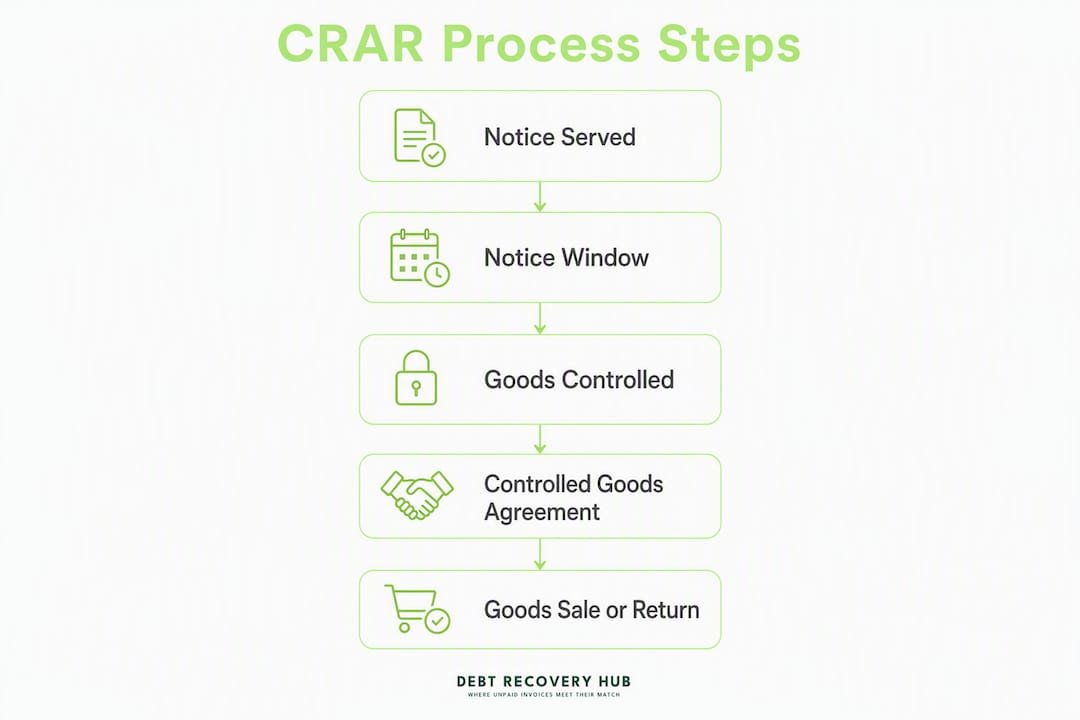
The Controlled Goods Agreement is the most common practical outcome. The tenant acknowledges the listed goods, agrees not to remove or sell them, and typically continues trading while clearing the debt. It balances recovery with continuity of trade, which tends to produce better outcomes than an immediate sale.
Who can use CRAR? An eligibility checklist
CRAR is available only when every one of the following conditions is met:
- Written tenancy agreement. An oral tenancy, a licence to occupy, a tenancy at will, or a tenancy at sufferance does not qualify.
- Wholly commercial premises. Any residential element, however small, removes the right. Mixed-use properties are excluded.
- Net unpaid pure rent meets the minimum. Under the Taking Control of Goods Regulations 2013, the net unpaid rent must equal at least seven days’ rent both when the notice is served and when the agent attends to take control.
- No deductions that reduce the figure below the minimum. Tenant set-offs, deposits, or overpayments must be netted off before you calculate whether the threshold is met.
- The landlord-tenant relationship is subsisting. CRAR cannot be used after the lease has ended.
Edge cases worth knowing:
- Sub-tenants: A head landlord can serve notice on a sub-tenant to redirect rent payments, but the sub-tenant’s liability is capped at the sub-rent owed.
- Tenancies at will and licences: Neither qualifies. If your occupier has no written lease, CRAR is unavailable regardless of arrears.
- Mixed-use premises: Even a small residential element (a flat above a shop let under one lease) disqualifies the whole property.
Pro Tip: Before instructing an agent, pull the lease and identify every sum described as “rent.” Isolate the pure rent figure by stripping out service charges, insurance, and any other non-rent items. If the lease is ambiguous, take brief legal advice before serving notice — an incorrect arrears figure can invalidate the entire enforcement.
How does the CRAR process work step by step?
The procedural workflow is tightly regulated. A single misstep — wrong arrears calculation, defective notice, attendance before the notice window closes — can invalidate enforcement and expose you to a wrongful interference claim.
The step-by-step workflow
- Verify eligibility. Confirm written lease, wholly commercial premises, and net unpaid pure rent at or above the minimum threshold.
- Calculate net unpaid pure rent. Strip out all non-rent sums. Apply any tenant credits, deposits, or set-offs. The figure must meet the minimum both at notice and at attendance.
- Instruct a certificated enforcement agent. Only a certificated agent may execute CRAR. Provide: the lease, a rent statement showing the arrears, the tenant’s full name and registered address, and written authorisation to act.
- Serve the Notice of Enforcement. The agent serves the notice on the tenant. From 1 May 2026, the minimum notice period is 14 clear days, excluding Sundays, bank holidays, Good Friday, and Christmas Day. Before that date, 7 clear days applies.
- Notice window. The tenant has the notice period to pay in full, negotiate, or apply to court. Many cases resolve here — payment or a repayment agreement during the notice window is a common outcome.
- Agent attendance. After the notice window closes, the agent attends the premises during permitted hours, identifies goods, and either secures a CGA or takes control of goods.
- Controlled Goods Agreement or removal. If the tenant signs a CGA, goods remain on site under the agreement. If not, the agent may remove goods for storage pending sale.
- Sale. If the debt remains unpaid and no CGA is in place, the agent arranges sale (usually by auction) after a further statutory period. Surplus proceeds above the debt and costs are returned to the tenant.
Timeline and typical durations
| Stage | Typical duration |
|---|---|
| Notice served to notice window closing | A clear-day notice period that increases after 1 May 2026, with a shorter period applying before that date |
| Payment or agreement during notice window | A period following notice during which tenants commonly pay or agree terms |
| Agent attendance after notice expires | Typically occurs soon after the notice period ends |
| CGA agreed at attendance | Same day as attendance |
| Removal to sale (if no CGA or payment) | Generally occurs within a few weeks from removal, subject to auction availability |
| Full recovery via sale | Usually takes several weeks from notice in straightforward cases |
Pro Tip: If you have credible evidence that the tenant is removing or dissipating assets, you can apply to court to shorten the notice period under the Taking Control of Goods Regulations 2013. You will need specific evidence of asset movement — a general suspicion is not enough.
What rights does a tenant have during CRAR?
Knowing the tenant’s options is not just academic. A landlord who understands them can prepare a stronger file and avoid the procedural gaps that invite challenges.
Tenant remedies and protections include:
- Payment or negotiation during the notice window. The tenant can pay in full or agree to a repayment plan before the agent attends, which ends the enforcement.
- Application to court. A tenant can apply for an order setting aside or varying the enforcement notice, particularly where the landlord has miscalculated the arrears or served a defective notice.
- Relief from forfeiture. Where CRAR is used alongside or instead of forfeiture proceedings, a tenant may apply to court for relief. This is one reason why the decision between CRAR and forfeiture must be made before any action is taken.
- Wrongful interference claim. If the landlord or agent takes control of goods unlawfully — wrong premises, defective notice, uncertificated agent — the tenant can claim damages for wrongful interference with goods and trespass; this is similar to issues addressed in abusive debt‑collection tactics where enforcement ethics and legality are crucial.
- Protected goods. Certain goods cannot be taken: items subject to a hire-purchase or finance agreement (not owned by the tenant), tools and equipment essential to the tenant’s trade up to a prescribed value, and goods belonging to third parties on the premises.
The Controlled Goods Agreement itself gives the tenant a degree of protection: goods remain on site and the tenant continues trading, which is usually preferable to immediate removal. During the notice window, the tenant can also request a detailed breakdown of the arrears claimed, and any error in that figure is grounds for challenge.
Document everything. Photograph the premises before and after attendance, keep copies of all correspondence, and retain the rent ledger showing how the pure rent figure was calculated. If a wrongful interference claim arises later, that paper trail is your defence.
When can CRAR not be used?
CRAR has hard statutory limits and some strategic traps that are just as dangerous.
Statutory exclusions:
- Residential or mixed-use premises (any residential element disqualifies the property).
- Licences to occupy, tenancies at will, and tenancies at sufferance.
- Oral tenancies with no written agreement.
- Cases where the arrears consist entirely of service charges, insurance, or other non-rent sums that the lease does not define as rent.
- Enforcement after the lease has ended.
Strategic reasons to avoid CRAR:
- Forfeiture waiver. Using CRAR after you know of a breach capable of triggering forfeiture can be construed as affirming the lease and waiving your right to forfeit. If lease termination is your primary objective, take legal advice before serving any CRAR notice.
- No valuable goods on site. If the tenant operates a service business with minimal physical assets, or has already removed stock, CRAR produces no practical recovery. A court claim or statutory demand may be more appropriate.
- Tenant insolvency. Once a tenant enters administration or liquidation, CRAR is subject to the moratorium rules. Acting without court permission can expose the landlord to contempt proceedings.
Pro Tip: If you are considering both CRAR and forfeiture, decide which is primary before you act. Demanding or accepting rent after knowledge of a breach can bar forfeiture independently of CRAR. Take legal advice at this decision point — it is the single most consequential choice in the process.
What are the costs and likely outcomes?
Cost elements
Enforcement agent fees are set by the Taking Control of Goods (Fees) Regulations and are structured in stages: a compliance stage fee (covering the notice), an enforcement stage fee (attendance and CGA or removal), and a sale stage fee. These fees are recoverable from the tenant in principle, but in practice the landlord may bear some costs if the tenant has no goods of sufficient value.
Additional costs can include storage, auction fees, and locksmith charges. Where a sale produces less than the debt and costs combined, the landlord absorbs the shortfall.
Keep receipts and a cost schedule. Courts and agents require proportionality in enforcement, and documented costs are easier to recover.
Outcome scenarios and timelines
| Outcome | Typical timeline from notice | Practical likelihood |
|---|---|---|
| Full payment during notice window | Occurs often during the notice period as many tenants pay after receiving notice | |
| Controlled Goods Agreement at attendance | A common practical outcome following the agent’s attendance | |
| Removal and sale, full recovery | A possible resolution over several weeks, depending on goods value | |
| Removal and sale, partial recovery | May occur when goods value is insufficient to cover the debt | |
| No recovery (no goods, tenant insolvent) | N/A | Realistic risk where tenant has stripped assets |
The LegalVision CRAR overview notes that CRAR is often quicker than a court claim and can prompt payment during the notice window — but it is not suitable where the landlord’s primary aim is to forfeit the lease.
What are the alternatives to CRAR?
CRAR is one tool among several. The right choice depends on what you actually want: cash recovery, lease termination, or both.
Forfeiture (peaceable re-entry or court order). Ends the tenancy and recovers possession. Faster than a court claim for money, but the tenant can apply for relief. Not available if you have waived the breach. Best when your primary goal is to end the lease and re-let.
County Court money claim. Recovers any sum owed under the lease, including service charges and other non-rent items CRAR cannot touch. Slower and more expensive than CRAR, but produces a judgment enforceable by multiple methods (warrant of control, charging order, attachment of earnings). Best for recovering the full debt including non-rent arrears.
Statutory demand. A precursor to winding-up or bankruptcy proceedings. Effective where the tenant is a company or individual with assets, and the debt is undisputed. The threat of insolvency proceedings often prompts payment. Not suitable where the debt is genuinely disputed.
Negotiated repayment plan. The lowest-cost option and the least damaging to the landlord-tenant relationship. Works where the tenant has a temporary cash-flow problem and a genuine intention to pay. Formalise any agreement in writing.
Combined approach. CRAR and a court claim can run in parallel for different elements of the debt: CRAR for pure rent arrears, a money claim for service charges. Take legal advice before combining remedies to avoid inadvertent waiver.
How to instruct a certificated enforcement agent
Getting the instruction right saves time and reduces the risk of a defective enforcement. Only a certificated enforcement agent may carry out CRAR; acting through an uncertificated individual risks trespass claims and personal liability.
Pre-instruction checklist
- Confirm the lease is written and wholly commercial.
- Calculate net unpaid pure rent (strip out all non-rent sums).
- Confirm the minimum threshold is met.
- Decide whether CRAR or forfeiture is your primary remedy.
- Gather documents: signed lease, full rent ledger, tenant’s registered name and address, proof of any notices already served.
Documents to provide to the agent
- The signed lease (or a certified copy).
- A rent statement showing the arrears broken down by quarter or month, with pure rent isolated.
- The tenant’s full legal name, trading name, and premises address.
- Written authorisation for the agent to act on your behalf.
- Any previous correspondence with the tenant about the arrears.
Questions to ask the agent before instructing
- Is your certification current, and which County Court issued it?
- Do you carry public liability insurance, and what is the cover level?
- Can you provide a sample Controlled Goods Agreement template?
- What is your fee structure at each enforcement stage?
- Do you have experience with commercial premises in this sector?
What to expect at attendance
The agent will attend during permitted hours, identify goods on the demised premises, and either secure a CGA or begin the removal process. You do not need to be present, but you should be contactable. If the tenant refuses entry, the agent has specific powers under the regulations — do not instruct the agent to force entry without legal advice.
Pro Tip: Debtrecoveryhub (DebtCollect.org) matches landlords to vetted, certificated enforcement agents based on the specific case type, arrears amount, and location. If you are unsure which agent to instruct, or want to compare options quickly, submitting your case details through the debt collection referral service takes the guesswork out of agent selection and connects you with specialists who handle commercial rent arrears regularly.

Key takeaways
CRAR is a powerful but procedurally unforgiving remedy: eligibility, notice accuracy, and agent certification must all be correct before enforcement begins.
| Point | Details |
|---|---|
| Pure rent only | CRAR recovers only the principal rent reserved by the lease; strip out service charges before calculating arrears. |
| Notice period from May 2026 | From 1 May 2026, the minimum notice period is 14 clear days; before this date, 7 clear days applies. |
| Certificated agent required | Only a certificated enforcement agent may execute CRAR; using an uncertificated individual creates liability. |
| Forfeiture waiver risk | Using CRAR after knowledge of a breach can waive the right to forfeit; decide which remedy is primary before acting. |
| Debtrecoveryhub | Debtrecoveryhub matches landlords to vetted certificated agents via its referral platform, reducing instruction risk. |
The case for getting the basics right before you act
Most CRAR disputes I see arise not from bad faith but from a landlord who moved too quickly. The notice goes out before the pure rent figure is properly isolated, or the agent instructed turns out not to hold a current certificate. Both errors are entirely avoidable, and both can turn a straightforward recovery into a costly wrongful-interference claim.
There is a broader point here about how landlords think about CRAR versus forfeiture. The conventional wisdom is that CRAR is the “quick win” and forfeiture is the nuclear option. That framing is misleading. CRAR is quick only when the tenant has goods worth taking and the landlord has done the eligibility work properly. Forfeiture, by contrast, can be the faster route to a clean outcome if the lease is genuinely at an end and re-letting is the goal. The mistake is treating them as sequential steps rather than as alternatives that require a deliberate choice at the outset.
The 2026 notice period change from 7 to 14 clear days matters more than it might appear. It doubles the window in which a tenant can dissipate assets, apply to court, or simply stall. Landlords who relied on the speed of the old 7-day notice as a tactical advantage need to recalibrate. The case for applying to court to shorten the notice period where there is genuine evidence of asset movement is now stronger than it was.
Finally, the Controlled Goods Agreement deserves more credit than it typically gets. It is not a consolation prize. A well-drafted CGA, secured by a competent agent, often produces full recovery over a short period while keeping the tenant trading and the lease intact. That outcome is frequently better than a rushed sale that realises a fraction of the debt.
Debtrecoveryhub can match you to a vetted CRAR agent
Recovering commercial rent arrears through CRAR means getting the right certificated agent on the case quickly, with the correct documents in hand and the eligibility checks already done. That is exactly where Debtrecoveryhub adds practical value.

Debtrecoveryhub operates a referral platform that matches landlords and property managers to vetted, certificated enforcement agents based on the specifics of the case: arrears amount, premises type, location, and urgency. Rather than searching for an agent independently and hoping their certification is current, you submit your case details once and receive a matched recommendation from specialists with a track record in commercial rent recovery.
To get started, submit your case through the debt recovery quote form with the basic details: lease type, arrears amount, premises address, and whether you have already served notice. The platform handles the matching; you focus on the outcome.
This article is general information, not legal advice. Verify agent certification independently and consult a solicitor where lease termination, insolvency, or complex legal questions arise.
Useful sources and primary references
The following primary sources and authoritative guides are the starting point for any CRAR matter:
- Tribunals, Courts and Enforcement Act 2007 — the primary statute; read Part 3 and Schedule 12 for the mechanics of taking control of goods.
- Taking Control of Goods Regulations 2013 — the detailed procedural rules: notice requirements, permitted hours, fee stages, and sale procedures.
- Witan Solicitors — CRAR guide — practitioner commentary including the 2026 notice period change; useful for up-to-date procedural notes.
- LegalVision — CRAR process overview — accessible step-by-step guide comparing CRAR with forfeiture and court claims.
- Courtroom Advice — CRAR step-by-step guide — practical guidance on CGAs and enforcement outcomes.
- CIVEA — the Civil Enforcement Association; use to verify agent certification status and find certificated agents.
- Insolvency Service — taking control of goods FAQs — official guidance on the three routes by which a creditor may take a debtor’s goods, including the rent arrears route.
How to use these sources: start with the statute for the legal mechanics, the Taking Control Regulations for procedural detail, and the practitioner guides for interpretation. Use CIVEA to verify any agent before instructing. For agent matching, the Debtrecoveryhub services page explains how the referral process works.
FAQ
What does CRAR stand for?
CRAR stands for Commercial Rent Arrears Recovery. It is the statutory procedure under the Tribunals, Courts and Enforcement Act 2007 that replaced the old common law right of distress on 6 April 2014.
What is the CRAR process in brief?
A certificated enforcement agent serves a Notice of Enforcement on the tenant (minimum 14 clear days from 1 May 2026; before that date, the minimum is 7 clear days), then attends the commercial premises to take control of goods or secure a Controlled Goods Agreement if the arrears remain unpaid.
Can a landlord ignore the notice period and act immediately?
No. Attending before the notice window closes invalidates the enforcement and exposes the landlord to a wrongful interference claim. The only exception is a court order shortening the notice period, which requires specific evidence of asset dissipation.
Can CRAR be used for service charge arrears?
Not unless the lease expressly defines service charges as rent. CRAR recovers only “pure rent” reserved by the lease; service charges and insurance contributions require a separate court claim.
How does Debtrecoveryhub help with CRAR cases?
Debtrecoveryhub matches landlords to vetted, certificated enforcement agents through its referral platform, based on the arrears amount, premises type, and location. Submit your case details via the debt collection page to receive a matched agent recommendation.