


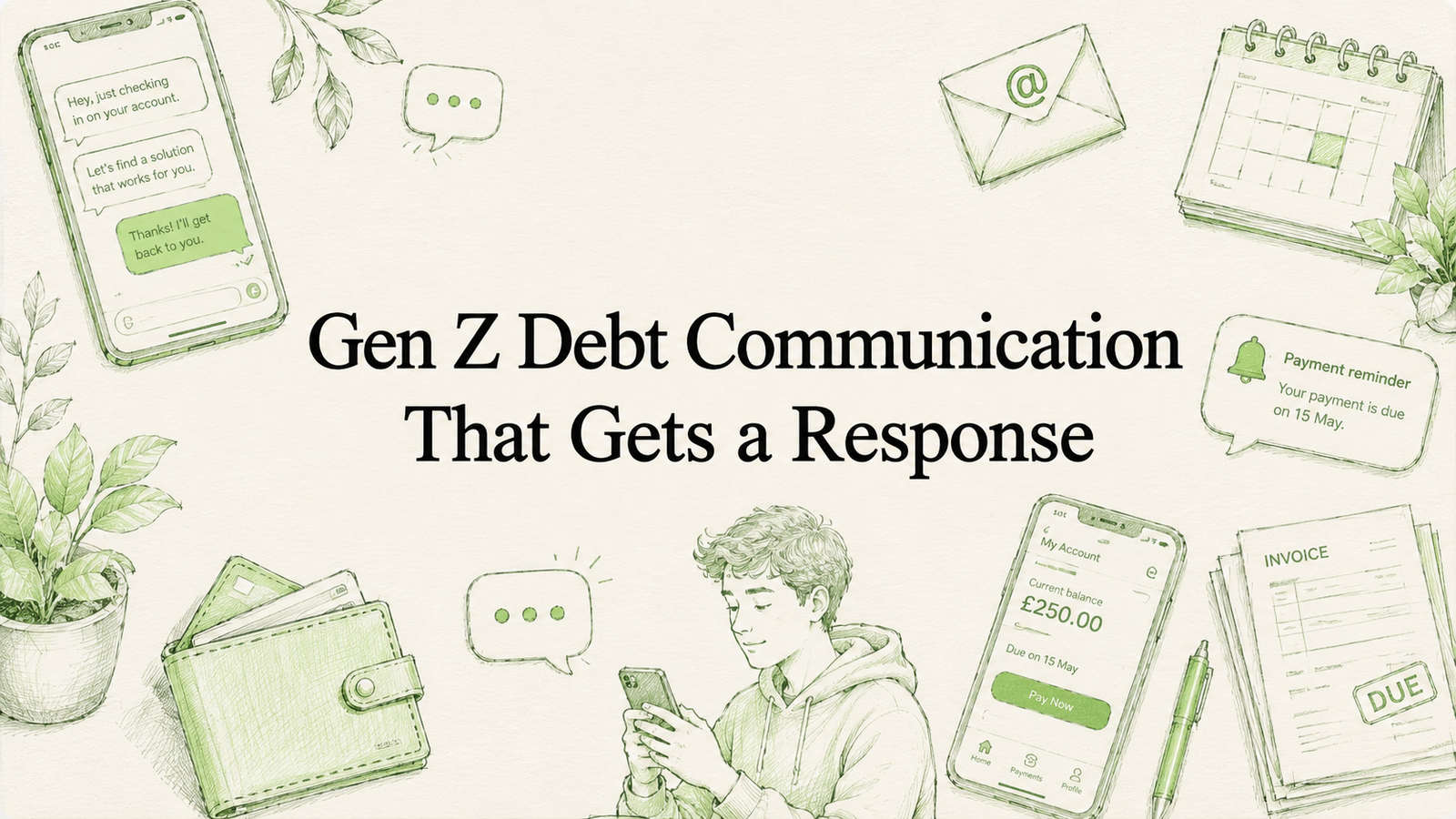
A missed invoice can feel especially stressful for generation z borrowers, long before it prompts a reply. If your first contact feels cold, confusing, or threatening, a younger debtor may avoid it, even when they want to resolve the balance.
Gen Z debt communication works when you lower the effort and emotional pressure involved in responding. You need clear facts, familiar digital channels, a private way to act, and realistic payment options.
The goal is not to make a person feel cornered. It is to make the next responsible step easy to understand and safe to take.
Key Takeaways
- Gen Z debt communication should reduce shame, uncertainty, and the effort required to respond.
- Start with clear account facts and offer private digital channels, such as email and secure portals, rather than relying on phone calls.
- Give people realistic choices, including full payment, an arrangement, document requests, and disputes, while respecting hardship and competing financial priorities.
- Put consent, privacy, legal compliance, human review, and clear automation controls before using AI or behavioural data.
- Measure sustainable resolution, completed arrangements, complaints, disputes, and longer-term payment success instead of rewarding clicks or one-off payments.
Debt Shame Can Turn a Manageable Balance Into Silence
Debt is often treated as a simple failure to pay. For many younger people, it is tied to embarrassment, insecurity, and fear about what happens next.
A Gen Z customer may have limited savings, variable work hours, high rent, student loan commitments, credit card debt, or several small Buy Now Pay Later repayments landing in the same month. Inflation and rising living costs can turn a previously manageable budget into financial distress with little warning.
When a message arrives without context, the recipient may assume the worst. They may worry about legal action, whether the matter could be reported to credit reporting agencies, or being judged by someone on the phone. Avoidance becomes a way to reduce immediate stress.
A debtor who does not respond is not always refusing to pay. They may be unsure what they owe, unable to pay in full, or afraid that any reply will make matters worse.
Your communication should reduce uncertainty before you ask for a payment.
Make the situation easy to verify
Start with the facts a person needs to check the account. Identify your business, state the balance, show the invoice or account reference, and give a secure route to review the underlying details.
Avoid vague phrases such as “urgent action required” when you have not explained the issue. Pressure may create a short-term response, but it can also increase complaints, disputes, and disengagement.
Use plain language. “Our records show an unpaid invoice for [amount]” is clearer than legalistic wording that a reader may misunderstand.
Respect the debts people prioritise first
Most people pay for housing, food, utilities, transport, and phone access before consumer debt repayment. That decision often reflects immediate survival needs, not a lack of intention.
You will get better engagement when you acknowledge that payment difficulty can exist and offer a route to discuss it. A payment arrangement, a short hold while documents are checked, or an option to dispute the invoice can prevent silence from becoming a prolonged delinquency.
Gen Z Debt Communication Needs Digital Choice, Not More Calls
Phone calls can feel intrusive, especially when the recipient is at work, in shared housing, or unsure who is calling. Effective digital collection strategies start with clear, private contact rather than relying on calls alone. Letters still have a role within traditional collections, but they are slower and offer less privacy or flexibility.
A Gen Z survey by PAIR Finance found that 51% preferred email for debt-related contact, offering insight into consumer preferences. Letters followed at 36%, while WhatsApp reached 8%, SMS 4%, and phone calls less than 1%. The study took place in Germany, so you should not treat the exact percentages as universal. Still, the direction is useful: begin with digital communication and give recipients control over communication channels and how they continue.

A practical channel order can guide payment reminders as well as other account notices:
| Channel | Best use | Main safeguard |
|---|---|---|
| First notice, documents, payment choices | Confirm address accuracy and provide a reply route | |
| Secure portal | Balance review, evidence, payment methods, and arrangement information | Use secure login and clear account information |
| SMS | Short reminder or portal prompt | Keep debt details out of lock-screen text |
| Phone | Requested support or complex questions | Offer a time window and respect contact preferences |
| Letter | Formal notices or unreachable accounts | Match the wording to the digital record |
Private digital access fits mobile-first financial services and digital-first behaviors. It still leaves room for different preferences.
Email gives the recipient time to read, verify, and act privately. SMS can prompt a return to a secure portal, but it should not reveal sensitive account details on a shared device.
Timing matters as well. Carefully applied behavioral intelligence can help test lunchtime and afternoon contact windows against first-party results, consent settings, and customer feedback. Do not send repeated messages late at night or during periods the person has said are unsuitable.
Why BNPL, Credit Cards, and Cost Pressures Change the Conversation
Buy Now Pay Later products can make individual purchases feel affordable because each instalment is small. However, several repayment schedules can overlap with rent, subscriptions, credit card debt, unsecured personal loans, and everyday costs.
The Consumer Financial Protection Bureau’s research on BNPL use found that BNPL users with credit cards were more likely to be at least 30 days late on those cards than non-users, 9% compared with 3%. That does not mean BNPL causes every missed payment. It does show that someone may be managing credit card debt alongside BNPL repayments and wider financial pressure.
Reported late payments, delinquency rates, and formal defaults are different measures. They should not be treated as equivalent to a charge-off rate. LendingTree found that 47% of BNPL users reported paying late during the previous year. By contrast, CFPB market data reported a 1.83% charge-off rate for BNPL loans in 2023. A late instalment may be corrected quickly, while a charge-off reflects much longer non-payment.
When you communicate with a younger debtor, avoid assumptions about why they missed an invoice. You may be dealing with competing due dates, an unexpected expense, reduced income, or a genuine billing error.
Payment preferences also vary by income, employment stability, and the individual account. Do not build decisions around stereotypes about gender or age. Clear explanations of each balance and the available choices can support financial literacy. Give each person the same options: pay in full, propose an arrangement, ask for documents, or raise a dispute.
Build a Payment Journey That Gives People Agency
A good recovery journey makes every stage predictable. The person should know what they owe, what happens if they pay, what happens if they cannot, and how to get help without calling a stranger.

Start with a simple sequence rather than an escalating series of generic payment reminders:
- Send an email that identifies the balance, due date, invoice reference, and secure portal link.
- Let the recipient review documents, payment history, payment methods, and payment options, including full payment or an arrangement, without waiting for an agent.
- Send a short SMS reminder only where your records and applicable rules allow it. Point to the portal rather than putting account details in the text.
- Offer a phone appointment for people who want to talk through the balance, need accessibility support, or have a complex dispute.
Well-designed self-service portals should show a complete picture. Hidden fees, unclear plan terms, or payment buttons that appear before the balance breakdown can destroy trust. If interest, charges, or collection costs apply, explain the basis, amount, and date before the person commits.
For a commercial unpaid invoice, preserve the business relationship where possible. A 22-year-old sole trader or founder may be dealing with a temporary cash-flow gap, not ignoring your terms. In B2B debt recovery, fair collection practices can recover more than a hostile demand that forces a viable customer to disengage.
Track arrangement completion, complaints, missed payments, and delinquency rates. Sustainable debt recovery rates matter more than immediate clicks or one-off payments.
Before you appoint debt collection agencies, prepare the contract, invoice, delivery evidence, payment history, and any dispute correspondence. If you need help finding an appropriate specialist, Commercial Debt Recovery can help you assess your options without forcing you to appoint the first provider you contact.
Put Compliance and Consent Before Automation
Digital contact does not remove your legal and ethical duties or the safeguards required in traditional collections. It changes the contact strategies you must govern and adds risks around privacy, identity, contact frequency, and automated decisions.
This is operational guidance, not legal advice. Your legal adviser or compliance lead should check the rules that apply to your jurisdiction, debt type, and relationship with the debtor.
Separate consumer, sole-trader, and business accounts
Consumer debt, including credit card debt, can carry protections that do not apply to a limited company invoice. Still, a sole trader, personal guarantor, or individual director may have personal-data and consumer-law considerations even where a business debt is involved.
For debt recovery UK activity, the FCA’s Consumer Credit sourcebook applies to regulated consumer credit collection. It requires firms to treat customers fairly and follow fair collection practices. It prohibits misleading, oppressive, or unfair conduct. Your use of personal data also needs a lawful basis under UK GDPR, while PECR can affect some electronic communications.
In the United States, third-party collectors must consider the CFPB’s Regulation F rules. The rules cover electronic communication, opt-out rights, inconvenient contact times, and limits on repeated telephone calls. Your process must also account for state laws, which can impose tighter requirements.
Use a four-part control process
- Confirm the account and contact record. Check that the invoice, balance, recipient identity, email address, and mobile number are correct before sending anything. A message to the wrong person creates a privacy problem and damages trust.
- Classify the communication. Mark whether it is a service notice, a payment reminder, a formal collection contact, or marketing. Do not assume a marketing consent rule applies in the same way to a genuine account message, or that it removes other collection obligations.
- Record preferences and opt-outs. Keep a single record for requested channels, unsuitable times, email unsubscribes, SMS STOP requests, complaints, vulnerability disclosures, and representation by an adviser.
- Review automated messages before release. Give each template an owner, version record, approval date, and regular quality review. Stop an automated sequence when a person disputes the balance, requests help, or agrees a plan.
Conversational AI can answer routine questions, surface payment options, and direct a person to documents. It should never pretend to be human, make legal claims it cannot support, or pressure someone into an unsuitable arrangement.
Keep human review available. Escalate when a person raises hardship, fraud, identity theft, bereavement, a dispute, or any sign that the automated route is making the situation worse.
Templates That Make It Easier to Reply
The strongest payment reminders are direct, brief, and factual. They give someone a way to act without requiring them to explain their personal circumstances in the first reply.
Initial email
Subject: Find payment options for your [Business Name] account
Hello [First Name],
Our records show an unpaid balance of [amount] for [invoice or account reference], due on [date]. You can review the invoice, payment methods, and any available arrangement in our secure portal: [secure link].
If you believe the balance is incorrect, or you need to discuss a different arrangement, reply to this email or contact us through the portal.
Thank you,
[Business Name and contact details]
SMS reminder
[Business Name]: Your account has a payment update ready to review. Use your secure link: [link]. Reply STOP to opt out of text messages.
Keep the text neutral. Don’t include the balance, a threat of action, or details that could expose the debt to anyone who sees the phone screen.
Portal message after a missed arrangement payment
Your agreed payment of [amount] was not received on [date]. You can make the payment, choose a new available date, or send us a message if your circumstances have changed. Please review the options before [date].
The tone stays factual while making space for a person to re-engage. It does not imply dishonesty or demand a personal explanation.
| Do | Don’t |
|---|---|
| State the balance, source, and due date clearly. | Send a vague message that makes the person call for basic facts. |
| Offer a secure portal and an accessible human contact route. | Force a phone conversation as the only way to resolve the matter. |
| Explain fees, interest, and consequences accurately. | Use threats, countdown pressure, or consequences you cannot lawfully take. |
| Respect opt-outs and requested contact times. | Restart contact through another channel to bypass a clear preference. |
| Pause automation during disputes or hardship discussions. | Treat every missed reply as deliberate avoidance. |
Use AI and Behavioural Data With Clear Limits
Behavioral intelligence can identify whether someone usually responds by email, opens a portal after an SMS, or needs a reminder at another time. Conversational AI can route routine questions to self-service tools, reducing operational work without impersonating a human or pressuring someone.
However, behavioral analytics should improve access, not exploit vulnerability. Don’t use browsing signals, inferred financial stress, or sensitive personal data to intensify contact. Avoid models that decide someone is “high risk” without a way for a human to review the decision.
Measure genuine resolution across portfolios, including accounts involving credit card debt, without labelling individuals as inherently risky. Track portal visits, verified dispute resolution, completed arrangements, complaints, opt-outs, delinquency rates, and payment success after 30 or 60 days. Open rates alone can reward attention-grabbing messages that make people feel worse.
For debt recovery UK teams and overseas agencies, maintain an audit trail for every automated decision. You should be able to show what data triggered a message, which template went out, and how a person could reach a human.
Frequently Asked Questions
What makes Gen Z debt communication more effective?
Effective communication is clear, factual, private, and easy to act on. It should explain the balance and available choices without using shame, threats, or unnecessary pressure.
Should debt collectors contact Gen Z customers by phone?
Phone support still has a role for requested help, accessibility needs, and complex questions. It should be one option among email, secure portals, SMS prompts, and letters, with contact times and preferences respected.
What should a debt communication include?
Identify the business, balance, invoice or account reference, due date, and a secure way to review the details. Also explain how the person can pay, propose an arrangement, request documents, or dispute the balance.
How can businesses use AI responsibly in debt recovery?
AI can answer routine questions and direct people to payment options, but it should not impersonate a human, exploit vulnerability, or make unsupported legal claims. Keep human review available and pause automated contact when someone raises hardship, fraud, identity theft, bereavement, or a dispute.
How should businesses measure a debt communication strategy?
Track verified dispute resolution, completed arrangements, complaints, opt-outs, delinquency rates, and payment success after 30 or 60 days. Open rates and immediate clicks alone can reward messages that attract attention without creating a sustainable resolution.
A Better Recovery Approach Starts With Respect
You will not improve recovery by treating Gen Z silence as a character flaw. Clear information, private digital options, and fair choices about next steps give people a reason to respond.
Effective Gen Z debt communication balances firm account management with a tone that neither shames nor traps the recipient. When people can verify the balance and raise concerns, they can choose a realistic payment route. That makes a sustainable resolution more likely.