




Where you can no longer rely on a no-fault Section 21 route, managing tenant rent arrears is vital for maintaining landlord cash flow and robust credit control. Mandatory rent arrears under Ground 8 can give you a stronger position, but only when the figures, notice and evidence all stand up in court.
Ground 8 is not a shortcut around poor record-keeping. Handling a late payment from a defaulted debtor requires precise procedural compliance. You must prove the right arrears threshold at the right times, using lawful rent figures and a valid notice. This guide is practical information for landlords and property businesses, not a substitute for advice from a housing solicitor.
Key Takeaways
- Ground 8 can provide a mandatory possession route, but you must apply the correct current rent arrears threshold and prove it both when serving notice and at the hearing.
- A clear, reconciled rent schedule should match the tenancy agreement, bank records, payments, benefits, credits and any repayment arrangements.
- A valid section 8 notice, accurate tenant details, correct notice period and reliable service evidence are essential; mandatory possession is not automatic.
- Investigate disputed payments, disrepair allegations, deposits and guarantor credits before issuing proceedings, as these may affect the arrears balance or lead to a counterclaim.
- Residential Ground 8 claims must be kept separate from commercial debt recovery, unpaid commercial invoices and Late Payment Legislation, which follow different rules and procedures.
How Ground 8 Works After Section 21
Ground 8 is a mandatory possession ground under Schedule 2 of the Housing Act 1988. If you prove the required arrears at both the notice date and the hearing, the court must usually make a possession order, provided you have met the procedural requirements.
The landlord is a creditor seeking recovery of an outstanding debt through a structured legal recovery process. That differs from commercial recovery, where payment terms and Late Payment Legislation may govern commercial invoices and unpaid commercial invoices.
That also differs from discretionary grounds such as Ground 10 and Ground 11. With those grounds, a judge can consider the circumstances and decide whether possession is reasonable. Ground 8 gives the court less discretion, but it also demands a precise case.
The current wording and commencement provisions matter. You should check the Housing Act 1988 possession grounds before serving notice, especially if your tenancy began under an earlier regime or falls outside the standard assured tenancy rules.
Ground 8 commonly applies where rent is payable weekly, fortnightly, monthly, quarterly or yearly. It does not apply automatically to every occupier or every property arrangement. For example, a company let, a licence arrangement or a commercial lease may require a different legal route.
Commercial payment terms and Late Payment Legislation generally belong to a separate recovery process. They may assist with unpaid commercial invoices, but they don’t replace the statutory requirements for residential rent arrears or determine a Ground 8 claim.
The rent arrears threshold you must prove
For claims under the earlier Ground 8 rules, the familiar thresholds were:
- At least eight weeks’ rent unpaid where rent was due weekly or fortnightly.
- At least two months’ rent unpaid where rent was due monthly.
- At least one quarter’s rent more than three months overdue where rent was due quarterly.
- At least three months’ rent more than three months overdue where rent was due yearly.
However, post-Section 21 reforms have changed the arrears threshold for many new claims. Under the revised Ground 8 approach, you may need to show at least three months’ rent arrears, or 13 weeks where rent is payable weekly. Don’t apply an old two-month calculation without checking which rules govern your claim.
Your calculation must cover rent lawfully due. It should not simply reproduce the tenant’s account balance. Part-payments, benefit payments, deposits, rent variations, court orders and agreed repayment plans can all change the total.
Commercial invoices and unpaid commercial invoices require different evidence, including the agreed payment terms. Don’t use that commercial approach as a substitute for a properly prepared residential rent schedule.
Why arrears must still exist at the hearing
Meeting the threshold when you serve notice is only half the task. The arrears must normally remain at or above the threshold when the court hears the possession claim.
A tenant may make a substantial payment shortly before the hearing. Meanwhile, further rent may fall due during an adjournment. You should update the rent schedule before every hearing date and re-check the qualifying figure.
A Ground 8 claim can fail even where your notice was valid if the arrears fall below the statutory threshold by the hearing date.
Proving Mandatory Rent Arrears Under Ground 8
A court file should tell one consistent story. Your tenancy terms, bank records, correspondence and rent schedule should all show the same dates, charges and credits.
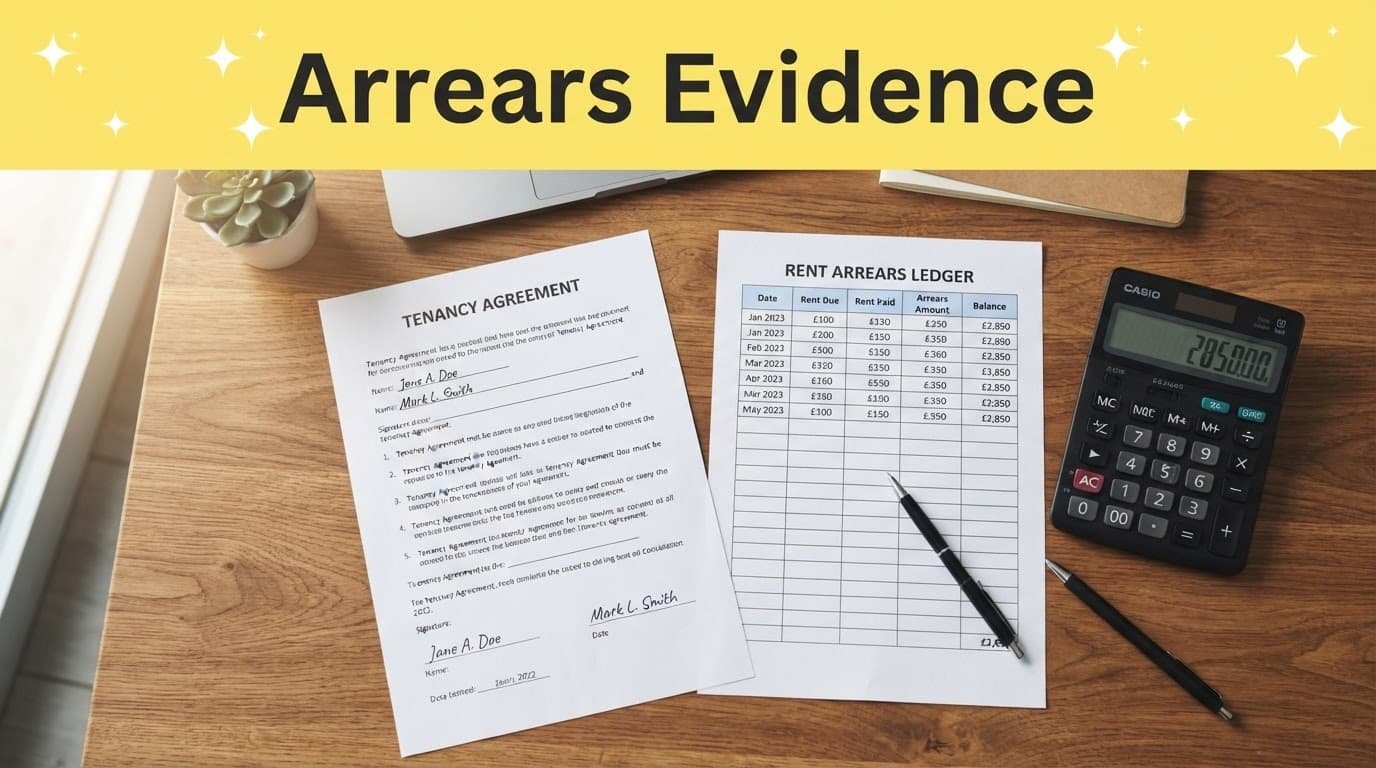
Start with the signed agreement, or the clearest written record of agreed terms where the tenancy was not signed. Add the notice of rent changes, if any, and identify the contractual rent due date.
A residential rent claim differs from standard debt collection involving commercial invoices. In a business dispute, a Letter Before Action may precede a legal claim for unpaid commercial invoices under agreed payment terms and Late Payment Legislation. Keep that process separate from a Ground 8 possession claim.
You should also retain:
- A full rent statement showing every charge, payment, credit and running balance.
- Bank statements that match the payments shown in the statement.
- Arrears letters, emails, text messages and records of repayment discussions.
- Benefit information where Housing Benefit or Universal Credit payments affect the account.
- The possession notice, proof of service and a short chronology of key events.
A transparent account is more persuasive than a large bundle of unexplained papers. If you applied a credit, reversed a charge or accepted payment from a guarantor, show it clearly.
Residential rent should not be recorded as commercial invoices simply to support recovery. Unlike unpaid commercial invoices, rent arrears depend on the tenancy agreement, possession procedure and Ground 8 requirements. The tenancy’s payment terms still need to be clear, while Late Payment Legislation does not replace the residential possession rules. If you need to correct or update the rent ledger, seek advice from solicitors before filing.
Prepare a rent schedule that a judge can follow
Your schedule should show each rent period, the due date, rent charged, payment received, payment date, adjustments and the running arrears balance. Keep rent separate from repair costs, service charges, late fees and damage claims unless the tenancy and applicable law clearly make them recoverable as rent.
For example, a simple reconciliation can look like this:
| Account item | Amount |
|---|---|
| Opening arrears | £0 |
| Rent charged for two monthly periods | £2,400 |
| Payment received | £600 |
| Closing rent arrears | £1,800 |
Check every line against your bank records before filing. An unexplained £600 payment can turn a mandatory claim into a disputed accounting exercise.
Prove the notice and service were valid
Use the prescribed possession notice, usually a section 8 notice, and name every tenant correctly. State Ground 8 accurately, include clear arrears particulars and allow the required notice period.
Service evidence matters. Keep a certificate of service, a witness statement, delivery evidence or another reliable record showing when and how you served the notice. A strong rent schedule cannot repair an invalid notice.
Shelter’s professional guidance on Ground 8 possession claims also highlights the need to meet the arrears test at both stages. If tenancy status or service is unclear, take legal advice before issuing a claim.
What to Do When the Tenant Disputes the Arrears
A dispute does not always mean the tenant is avoiding payment. They may say a benefit payment went to the wrong account, a rent increase was invalid, a guarantor made a payment you missed, or disrepair should reduce the rent due.

Investigate each point rather than dismissing it. Ask for payment references, benefit statements, photographs, repair reports or correspondence. Then send a written reconciliation that explains what you accepted, what you rejected and why.
Disrepair allegations may lead to a set-off or counterclaim. Damage, repair costs and unpaid service charges are also not automatically rent arrears. You may need to pursue those debts separately.
For business-to-business agreements and commercial leases, Commercial Debt Recovery follows a different route. Late Payment Legislation may apply to commercial invoices, with statutory interest available on unpaid commercial invoices. Debt recovery services or a debt collection agency may help recover unpaid commercial invoices, rather than using a residential Ground 8 claim.
A mixed-use or commercial-to-residential tenancy needs careful classification. Confirm which agreement covers the disputed rent before relying on residential possession grounds. Late Payment Legislation may also apply to commercial invoices, but residential Ground 8 claims rely on the Housing Act and its statutory requirements.
Firm, respectful communication often produces better evidence and a clearer payment proposal. If your business needs help organising documents and approaching recovery responsibly, Commercial Debt Recovery can help you identify an appropriate specialist provider. Debt recovery services may suit straightforward accounts, while a debt collection agency can assist with agreed recovery work.
Ground 8 compared with discretionary possession grounds
Ground 10 may apply where some rent is unpaid when proceedings begin. Ground 11 concerns persistent delay in paying rent, even where the account is not above the Ground 8 threshold.
Both are discretionary. Therefore, a judge may refuse possession or make a suspended order where Ground 8 no longer applies. You may consider pleading suitable alternative grounds alongside Ground 8, subject to legal advice. Adding grounds does not guarantee possession, but it can protect your position if the arrears change.
Choose the right next step before issuing a claim
First, verify the tenancy type, parties and balance. Next, send an accurate arrears letter and consider whether a realistic repayment arrangement would resolve the debt.
If payment does not follow, serve the correct notice and issue proceedings only when the paperwork is ready. In complex cases, debt recovery solicitors are sensible, particularly where arrears are high-value, the tenant is a company, a guarantor is involved or the account is disputed. Consider formal legal proceedings only after checking whether a debt collection agency or negotiated settlement is more suitable.
Mistakes That Can Weaken a Mandatory Claim
Mandatory does not mean automatic. Procedural errors and incomplete evidence can delay or defeat the statutory recovery process.
Common mistakes include:
- Relying on an old Section 21 process when it no longer applies to the tenancy.
- Using the wrong Ground 8 threshold or failing to check current legislation.
- Applying commercial payment terms or Late Payment Legislation to residential rent, rather than following the tenancy agreement and statutory rules.
- Confusing unpaid commercial invoices with rent arrears, or treating commercial invoices as evidence of rent due.
- Missing payments, benefits or guarantor credits in the rent account.
- Serving the wrong form, naming the wrong party or allowing too little notice.
- Filing a schedule that does not match bank statements or rent demands.
- Ignoring disrepair allegations and assuming they cannot affect the account.
- Treating the balance at the notice date as fixed, despite further payments or rent becoming due.
- Treating the statutory recovery process as informal debt collection before issuing a legal claim.
Before you issue proceedings, check whether Late Payment Legislation has any application to the tenancy. Read the notice and schedule as if you were seeing them for the first time. Any gap in the evidence may become the tenant’s strongest argument.
Frequently Asked Questions
Can you use Ground 8 against a company tenant?
Usually, no. Ground 8 is part of the Housing Act 1988 assured tenancy framework, while a company let often falls outside it. You should check the lease terms and seek advice on the correct commercial recovery or possession route.
Does serving a section 8 notice end the tenancy?
No. The notice starts the possession process and tells the tenant which grounds you rely on. The tenancy normally continues until it ends lawfully, such as through surrender or a court order.
Can you claim the unpaid rent as well as possession?
Yes, you can usually seek a money judgment for arrears within possession proceedings. The court process and your claim form must state the amount accurately, including any continuing rent due up to the hearing.
How does commercial debt recovery apply to unpaid rent?
For an assured tenancy under the Housing Act 1988, unpaid rent is usually pursued through possession proceedings and a claim for arrears. If the court awards the debt, the landlord becomes the creditor and the tenant becomes the debtor for enforcement purposes.
After legal proceedings, you may secure a County Court Judgment and instruct county court bailiffs or a High Court enforcement officer, where appropriate. You may also engage a debt collection agency or use debt recovery services to pursue payment.
Commercial leases follow different rules and may involve commercial rent recovery, forfeiture or a separate debt claim. The lease terms and the type of property will determine the most suitable route.
Does a tenant’s deposit automatically reduce rent arrears?
No. A deposit is not usually treated as rent paid during the tenancy unless there is a clear agreement or lawful basis for doing so. Record it separately and do not reduce the arrears schedule without advice.
Can you pursue a guarantor for the arrears?
You may be able to, if the guarantee is valid and covers the debt claimed. Check its wording, whether it was properly executed, and whether you have complied with any notice requirements.
Careful Preparation Supports Fair Recovery
Ground 8 can provide a mandatory possession route when you prove the correct arrears threshold and follow every required step. Your strongest evidence is a reconciled rent account that matches the tenancy, payment records and notice.
Preserve service evidence, update the schedule before the hearing and check the current rules before taking action. Accurate records reduce delay and support a fairer recovery process. The same meticulous approach used in Commercial Debt Recovery and debt collection can support residential possession, with solicitors advising on the correct legal route.