
TL;DR:
- Start by reviewing your invoice details and sending a clear, written demand with a firm deadline. If there is no response, escalate to a formal Letter Before Action before pursuing court or collection agency options. Document all contact attempts and consider statutory interest and fixed costs when claiming unpaid invoices.
Start by checking your invoice and payment terms, then send one firm written demand with a clear deadline. If that gets no response, escalate through a Letter Before Action before considering court or a collection agency.
Immediate next steps:
- Verify the invoice details, due date, and agreed payment terms.
- Log every contact attempt with dates, times, and method.
- Send a formal written demand giving the debtor a clear, reasonable deadline to pay or respond.
Pro Tip: Document everything from day one. Courts and collection agencies rely on a clear paper trail. Under the Limitation Act 1980, you have six years from the payment due date to pursue a simple contract debt in England and Wales, but waiting erodes your chances. The Office of the Small Business Commissioner (OSBC) and the Federation of Small Businesses (FSB) both offer free guidance before you spend a penny on legal action.
Table of Contents
- How to recover unpaid invoices: the step-by-step chase ladder
- What statutory interest and fixed costs can you claim?
- When and how to issue a Letter Before Action
- What is the time limit for recovering a debt?
- Collection agency or court: which route makes more sense?
- Ready-to-use templates and phone scripts
- Key takeaways
- The mistake most SMEs make when chasing invoices
- Debtrecoveryhub: matched to the right agency for your case
- Useful sources
- FAQ
How to recover unpaid invoices: the step-by-step chase ladder
The Small Business Commissioner advises a tiered approach: polite reminders first, formal demand second, external recovery or court only after internal efforts fail. That sequencing matters because it preserves the relationship and builds the evidence trail you need if things escalate.
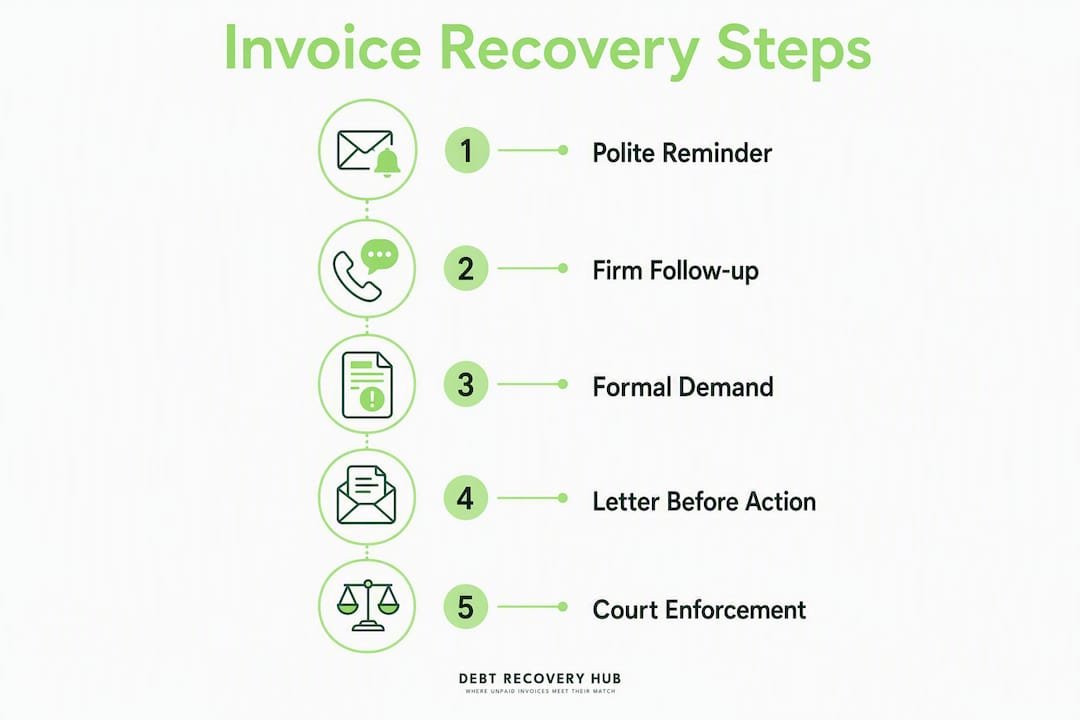
Days 1–7: polite reminder
Send a short, professional email the day after the due date. Keep the tone neutral.
- Subject: Invoice [number] — payment due [date]
- Body: confirm the amount, due date, and payment details; ask if there is any issue with the invoice.
- Follow up with a brief phone call if no reply within 48 hours.
Log the date, time, and outcome of every contact. A central spreadsheet or your accounting software works fine; the key is consistency.
Days 8–30: firm follow-up
If the first reminder draws silence or a vague promise, escalate the tone without escalating the language.
- Reference the original invoice number and the amount now overdue.
- State that you will add statutory interest if payment is not received within the specified deadline.
- Confirm in writing after any phone conversation: “As discussed on [date], payment of £X is due by [date].”
Pausing further work or credit for that client at this stage is reasonable and sends a clear signal without burning the relationship entirely.
Days 30–60: formal demand

A formal demand is not yet a Letter Before Action, but it should feel serious. State the total now owed (including any interest accrued), give a firm 14-day deadline, and make clear that failure to pay will result in formal legal proceedings.
Day 60+: Letter Before Action
If the formal demand produces nothing, issue a Letter Before Action (LBA). This is the last step before court. The Pre-Action Protocol requires you to give the debtor a reasonable time to respond before starting court proceedings, though the Ministry of Justice Pre-Action Protocol sets out the specific requirements. Skipping this step can count against you in court.
Research consistently shows that recovery chances fall sharply once an invoice passes 90 days overdue. Act before that window closes.
What statutory interest and fixed costs can you claim?
Under the Late Payment of Commercial Debts (Interest) Act 1998, businesses can claim statutory interest on overdue B2B invoices at the Bank of England base rate plus 8 percentage points. GOV.UK publishes an interest calculator and sets out the fixed compensation bands you can add on top.
Fixed compensation can be claimed according to bands applying to the debt amount as set out in the Late Payment of Commercial Debts Act.
These amounts are in addition to the interest, not instead of it. You can also claim reasonable debt recovery costs beyond the fixed sum if your actual costs exceed it.
Worked example: An invoice for £5,000 is 60 days overdue. At a Bank of England base rate of 5.25%, the statutory rate is 13.25%. The daily interest is approximately £1.82 (£5,000 × 13.25% ÷ 365). Over 60 days that is roughly £109 in interest, plus the £70 fixed compensation — a total of around £179 on top of the principal.
To avoid disputes later, include your right to claim statutory interest and fixed costs in your standard payment terms and on every invoice. A single line is enough: “We reserve the right to charge statutory interest and fixed compensation under the Late Payment of Commercial Debts (Interest) Act 1998.”
When and how to issue a Letter Before Action
A Letter Before Action is the formal trigger for legal proceedings. Courts expect to see one before a claim is issued, and omitting it can result in cost sanctions against you even if you win.
What your LBA must include
- Your full name and address, and the debtor’s.
- The invoice number(s), amount(s), and due date(s).
- A clear statement of the total now claimed, including interest and fixed compensation.
- A deadline for payment or a written response (30 days is standard for businesses).
- A statement that you will issue court proceedings if no response is received.
- Details of any dispute resolution options you are prepared to consider.
The FSB’s guidance confirms that a County Court Judgment (CCJ) is a powerful lever: it damages the debtor’s credit record and often prompts payment where softer steps have failed.
Escalation timeline and costs

| Stage | Typical duration | Approximate cost |
|---|---|---|
| Letter Before Action | 30 days response window | Your time only |
| Issue small claims | — | court fee (GOV.UK fee scale) |
| Default judgment (no defence) | — | Included above |
| CCJ granted | Immediate on judgment | Included above |
| Enforcement (e.g. enforcement agents) | — | £75 depending on method |
Court fees are recoverable from the debtor if you win, but only if the debtor can pay. Check GOV.UK’s County Court Judgment guidance for the current fee scale before issuing.
Evidence checklist for court
- Signed contract or written agreement confirming the work and price.
- The original invoice(s) with due dates.
- Proof of delivery or completion (emails, delivery notes, sign-off records).
- Full communications log (dates, times, method, summary of each contact).
- Copies of all reminders and demands sent.
- Any partial payments received and when.
After a CCJ, enforcement options include attachment of earnings, charging orders on property, or instructing enforcement agents. If the debtor is a company, you can also consider a statutory demand as a precursor to winding-up proceedings, though that route warrants legal advice.
What is the time limit for recovering a debt?
The Limitation Act 1980 gives you six years from the date payment was due to pursue a simple contract debt through the courts in England and Wales. Miss that window and the debt becomes statute-barred: you lose the right to court recovery entirely.
Six years sounds generous. It is not. Debts older than two years become progressively harder to collect. Debtors move, close companies, or become insolvent. Evidence goes stale. If you have an invoice that is more than two years old, check your legal options now rather than waiting.
Two important exceptions to the six-year rule:
- Debts created by deed (a formal legal document signed as a deed) carry a 12-year limitation period.
- Scotland and Northern Ireland operate under different limitation regimes. Scottish law applies a five-year prescription period under the Prescription and Limitation (Scotland) Act 1973. If your debtor is based in Scotland or Northern Ireland, take jurisdiction-specific advice.
The clock starts on the date payment was due, not the date you invoiced. If your terms say “payment within 30 days” and the invoice is dated 1 March, the limitation period begins on 31 March.
Collection agency or court: which route makes more sense?
Neither route is automatically better. The right choice depends on the debt’s size, age, and the debtor’s likely ability to pay.
Factors to weigh before deciding
- Debt size: Court is cost-effective for debts above roughly £1,000 where you have solid evidence. Below that, fees and time may outweigh recovery.
- Debt age: Agencies can sometimes recover older debts that court action would struggle with, particularly where the debtor is still trading.
- Debtor solvency: A CCJ against an insolvent debtor is worthless. Check Companies House for any insolvency notices before spending money on proceedings.
- Relationship value: If you want to keep trading with this client, a measured agency approach is less adversarial than a court claim.
- Speed: Agencies can begin contact within days. Court proceedings typically take months.
Cost-benefit snapshot
- Collection agencies typically charge a commission on recovered amounts. Net recovery depends on the commission rate and the debt size, so always get a clear fee structure upfront.
- Small claims court fees vary depending on the claim value and are recoverable from the debtor if you win and they can pay.
- Enforcement after a CCJ adds further cost and is not guaranteed to succeed if the debtor has no reachable assets.
Vetting an agency
Before instructing any agency, confirm it is authorised by the Financial Conduct Authority (FCA) where required, operates within the Competition and Markets Authority (CMA) guidelines on fair collection practices, and provides a written fee agreement before starting work. Aggressive or non-compliant tactics can expose you to reputational damage and complaints.
Pro Tip: Before instructing an agency, run a quick cost-benefit check: estimated commission versus likely court costs and success probability. For a £3,000 debt at 25% commission, you net £2,250 if the agency recovers in full. Compare that against court fees plus your time, and factor in whether the debtor has assets to enforce against. The Debtrecoveryhub debt collection service matches you with vetted agencies based on your specific debt profile, removing much of that selection guesswork.
Ready-to-use templates and phone scripts
Polite reminder email (days 1–7)
Subject: Invoice [Invoice Number] — payment due [Due Date]
Key lines to include:
- “I’m writing to remind you that invoice [number] for £[amount], dated [date], was due for payment on [due date].”
- “Please arrange payment at your earliest convenience using the bank details on the invoice.”
- “If there is any query with the invoice, please contact me directly so we can resolve it quickly.”
- Close with your name, contact number, and a copy of the original invoice attached.
Final demand / Letter Before Action checklist
A strong LBA covers these points in plain, firm language:
- Full details of the debt: invoice number, amount, due date.
- Total now claimed, including statutory interest and fixed compensation.
- Clear 30-day deadline for payment or written response.
- Statement that court proceedings will follow without further notice.
- Offer to discuss a payment plan if the debtor has a genuine cash flow issue.
- Your contact details and preferred payment method.
Avoid threatening language you cannot follow through on. Stating “we will issue court proceedings” is firm and accurate. “We will destroy your business” is not.
Phone call script
Opening: “Good morning, this is [your name] from [company]. I’m calling about invoice [number] for £[amount], which was due on [date]. Can you confirm when we can expect payment?”
If they dispute the invoice: “I understand. Can you tell me specifically what the issue is? I’d like to resolve this today if possible.”
Escalation line: “If we can’t agree a payment date today, I’ll need to follow up in writing with a formal demand. I’d prefer to avoid that.”
After the call: Send a confirmation email within the hour: “Following our call today, I confirm that payment of £[amount] is expected by [agreed date].”
Always note the call in your log immediately: date, time, who you spoke to, and what was agreed.
Key takeaways
The most effective way to recover unpaid invoices in the UK is to act early, document everything, and escalate through a clear sequence: reminder, formal demand, Letter Before Action, then court or agency.
| Point | Details |
|---|---|
| Act within 7 days | Send a polite written reminder the day after the due date; recovery chances fall sharply after 90 days. |
| Claim statutory interest | Under the Late Payment of Commercial Debts Act, you can add interest at base rate plus 8%, plus fixed compensation of £40–£100. |
| Issue an LBA before court | A Letter Before Action with a 30-day response window is required by the Pre-Action Protocol; skipping it can cost you in court. |
| Six-year limitation period | In England and Wales, you have six years from the payment due date to pursue a simple contract debt through the courts. |
| Debtrecoveryhub matching service | Debtrecoveryhub matches businesses with vetted collection agencies based on debt type, age, and amount, reducing selection risk. |
The mistake most SMEs make when chasing invoices
Most small business owners chase too softly for too long, then panic and go straight to court without the evidence base to support it. The middle ground, a properly documented escalation with statutory interest added and a firm LBA issued at the right moment, is where most debts actually get paid.
There is a common belief that adding statutory interest will antagonise the debtor and make recovery harder. The opposite tends to be true. Referencing the Late Payment of Commercial Debts (Interest) Act in your demand signals that you know your rights and are prepared to enforce them. Debtors who were hoping you would give up quietly tend to respond differently when they see a calculated interest figure and a fixed compensation claim on a formal letter.
The other underrated factor is timing. Businesses that chase within the first week of a missed payment recover a significantly higher proportion of what they are owed than those who wait a month before making contact. That first call or email, even a brief one, resets the debtor’s expectation that silence is acceptable.
One more thing: if a client disputes the invoice, do not ignore the dispute. Acknowledge it in writing, ask for specifics, and resolve it or rebut it with evidence. An unresolved dispute can complicate a court claim and give the debtor grounds to delay proceedings.
Debtrecoveryhub: matched to the right agency for your case
Chasing a debt through court takes time, legal knowledge, and a strong evidence file. Instructing an agency without knowing their track record for your type of debt is a different kind of risk. Debtrecoveryhub removes both problems.
The platform matches businesses with vetted collection agencies based on the specifics of the case: debt type, amount, age, debtor location, and whether the debt is B2B or involves a property element. There is no guessing which agency handles your kind of claim, and no upfront fee to use the matching service. You submit your case details, Debtrecoveryhub identifies the most suitable agency from its vetted panel, and you receive a clear proposal before committing to anything.
It suits businesses with debts from a few hundred pounds upwards, including aged debts that have already been through the reminder and LBA stages. The agencies on the panel operate within FCA and CMA guidelines, which protects your reputation as well as your recovery prospects.
To get started, submit your case details via the quote form and receive a matched agency recommendation. You can also review the full range of services before deciding whether to proceed.
Useful sources
- GOV.UK: Late commercial payments — charging interest and debt recovery costs: the primary reference for statutory interest rates, fixed compensation bands, and the GOV.UK interest calculator.
- Office of the Small Business Commissioner: free guidance, templates, and mediation support for small businesses dealing with late payments
- FSB: What is the process for debt recovery?: practical process overview from the Federation of Small Businesses, including CCJ guidance
- Pre-Action Protocol for Debt Claims — Ministry of Justice: sets out the procedural requirements before issuing a court claim, including response timeframes.
- Limitation Act 1980 — legislation.gov.uk: the statutory basis for the six-year limitation period on simple contract debts in England and Wales.
- GOV.UK: County Court Judgments for debt: explains how CCJs work, their effect on the debtor’s credit record, and enforcement options
This article provides general information only and is not legal or financial advice. Verify current rules with GOV.UK or a qualified legal professional before taking court action.
FAQ
Is it illegal not to pay an invoice in the UK?
Failing to pay a valid invoice is a civil breach of contract, not a criminal offence. The creditor’s remedy is through the civil courts, typically a County Court claim or a CCJ.
What is the six-year rule for debt recovery?
Under the Limitation Act 1980, you have six years from the date payment was due to pursue a simple contract debt through the courts in England and Wales. After that, the debt becomes statute-barred.
What can I do if someone has not paid my invoice?
Send a formal written demand, add statutory interest under the Late Payment of Commercial Debts (Interest) Act 1998, and issue a Letter Before Action giving 30 days to respond. If that fails, issue a court claim or instruct a vetted collection agency through a service such as Debtrecoveryhub.
What is the law on unpaid invoices in the UK?
The Late Payment of Commercial Debts (Interest) Act 1998 entitles businesses to claim statutory interest at the Bank of England base rate plus 8%, plus fixed compensation of £40–£100 depending on the debt amount. GOV.UK publishes the current rates and an interest calculator.