

January payments from buy now pay later purchases can turn a quiet account into an urgent support request within days. Your January recovery plan must account for that shift before Christmas promotions and delivery cut-offs create the next wave of instalments.
If you lead a creditor team, a servicing partner, or a debt recovery agency, post-holiday demand affects more than collections volume. It brings more payment-plan requests, vulnerability disclosures, disputes, and referrals to debt advice.
The strongest January operation combines realistic forecasting with respectful contact and enough skilled capacity to prevent a payment problem becoming a debt trap.
Key Takeaways
- Forecast January BNPL recovery demand before festive lending peaks, using failed payments, repeat contacts, plan requests, and hardship disclosures as leading indicators.
- Route accounts by need rather than days past due, separating routine arrears from financial hardship, disputes, vulnerability, fraud, and account-takeover cases.
- Build flexible capacity with cross-trained staff, experienced case owners, strong quality assurance, and systems that pause inappropriate contact.
- Make self-service and free, independent debt advice part of the resolution path, including clear options for payment plans, disputes, preferred contact, and continuous payment authority requests.
- Use third-party debt collection and legal escalation carefully, with complete case records, accurate credit reporting, proportionate contact, and controls for complaints and vulnerability.
Why the January debt-advice spike reaches recovery teams
A buy now pay later purchase often feels manageable at checkout because the first payment is small or delayed. Even when presented as interest free credit, it may carry late payment fees under its terms, and a small or delayed first payment is not necessarily a full credit check.
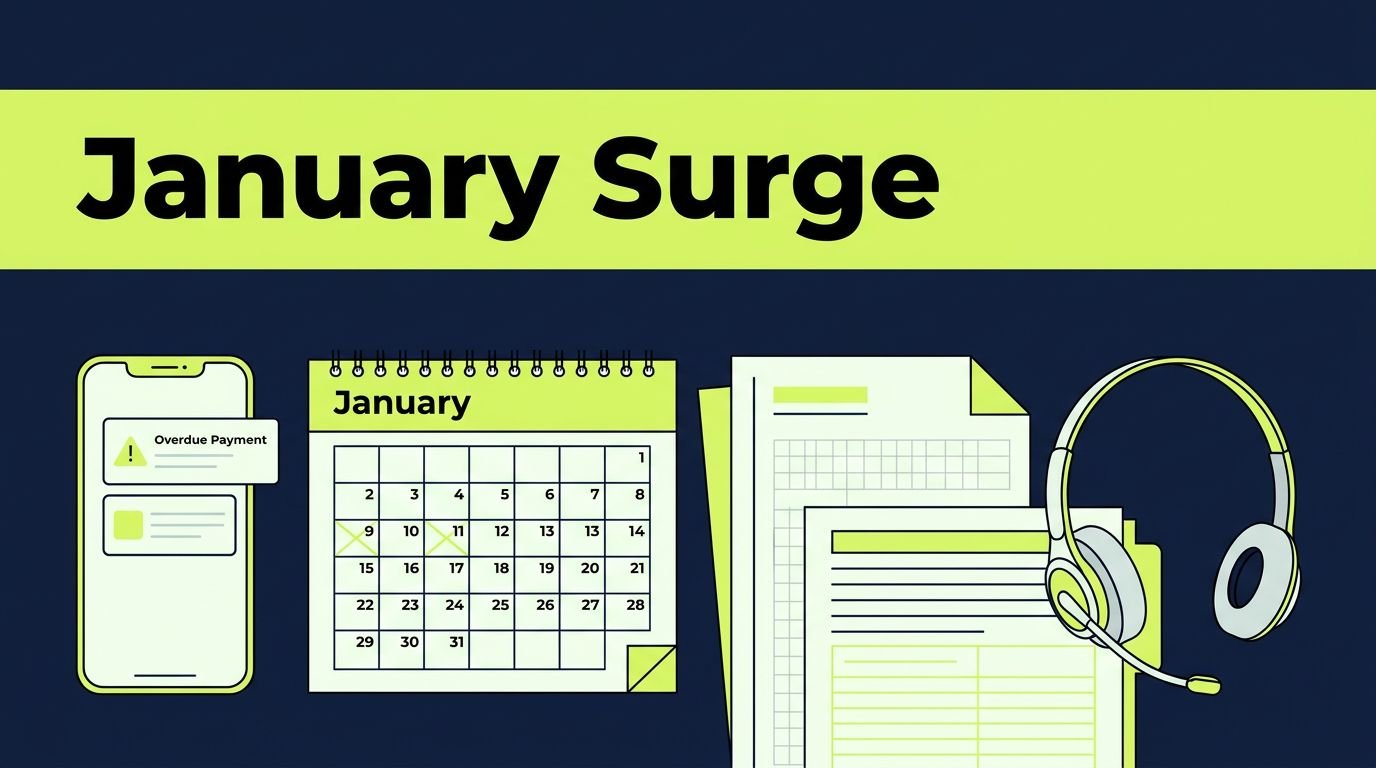
By January, several payment instalments may be due alongside rent, energy bills, travel costs, and reduced household income after the festive period.
That pressure does not mean every BNPL user will miss a payment. However, it does mean you should expect a change in the kind of contact customers make. Early messages may ask for a due-date change. Later calls may involve several providers, failed or cancelled continuous payment authority instructions, bank charges, or customers facing financial hardship and unable to meet essential costs.
The scale matters. The financial conduct authority (FCA) found that 20% of UK adults, around 10.9 million people, had used unregulated BNPL in the year to May 2024. Applicable consumer credit act protections should also be considered alongside the product’s regulatory status. Its later BNPL borrower protections recognise that these products now sit within everyday household borrowing.
Debt-advice demand also has a seasonal pattern. Money Wellness has described January as the traditional post-Christmas high point for BNPL support requests. A 2026 Fair4All Finance review of BNPL risks and trends also shows why repeated borrowing and everyday spending can contribute to a debt trap, making repayment problems harder to contain.
Your historic default rate is only one planning input. Review the dates when accounts were opened, the scheduled instalment calendar, failed payment attempts, previous January contacts, and the proportion of customers holding more than one agreement. A large cohort of December purchases can create a concentrated queue even when overall arrears remain stable.
Rising contact volumes are not a reason to speed up collections activity. They are a reason to separate routine payment failures from accounts that need time, information, or support.
Forecast January recovery demand before festive lending peaks
A workable BNPL debt recovery forecast starts before the busiest shopping period. Build three scenarios using your own buy now pay later account history, then agree the staffing response for each one in advance.
Your base case might reflect normal post-Christmas contact levels. A pressure case should model higher failed card payments, longer inbound wait times, and more requests to revise a payment date. A high-support case should assume a sharp rise in financial hardship, disputes, and customers who need a referral to debt advice.

Use leading indicators rather than waiting for 30-day arrears data. For example, monitor unsuccessful continuous payment authority attempts, incomplete portal journeys, repeat calls, email replies containing hardship terms, and complaint volumes. Those signals often arrive before accounts become seriously overdue.
Set clear operating actions for each scenario.
| Demand scenario | Operational trigger | Staffing response |
|---|---|---|
| Expected January flow | Contacts and payment failures follow prior-year patterns | Keep normal teams in place and reserve trained cover for peak days |
| Pressure period | Inbound queues, continuous payment authority failure rates, or plan requests rise above forecast | Move cross-trained staff into arrears support and extend quality monitoring |
| High-support period | Wait times, complaints, or vulnerability disclosures rise sharply | Limit outbound volume, prioritise case resolution, and add specialist oversight |
Do not treat all staffing as phone capacity. You also need people who can check a disputed balance, amend a plan, review a complaint, validate a third-party authority, and handle a customer who cannot safely speak at a set time.
Stagger outbound campaigns around known paydays and avoid sending large batches when inbound queues already exceed your service standard. A message that offers help can still generate a rush of calls. Plan for that response before the message goes out.
Route accounts by need, not only days past due
A single collections script cannot handle a January buy now pay later portfolio. Debt collectors need different routes for routine arrears, hardship, and disputes.
For early missed payments, give the customer a clear balance, due date, and route to pay or request help. Explain any applicable late payment fees accurately, without implying charges always apply or that legal action is imminent when it is not. A prompt reminder can help, but repeated messages across several channels may feel threatening when a customer already faces overlapping instalments.
When someone says they cannot afford the scheduled amount, move the account into a financial hardship path. Train agents to record only information needed to assess the request, offer breathing space, and complete proportionate affordability checks before considering an affordable arrangement. They should also offer a referral to debt advice when broader support is needed, and explain what evidence is required without turning the conversation into an interrogation.
Disputes need their own route, with staff checking the underlying credit agreement before collection continues. Goods that were returned, cancelled, not delivered, or charged incorrectly should not sit in a standard arrears queue. Neither should reports of fraud, account takeover, or an unresolved merchant complaint. Continuing collection while basic facts remain untested can cause avoidable harm and create expensive complaint handling later.
Build these rules into your customer relationship management system:
- Suppress routine automated contact when an active dispute, vulnerability flag, agreed payment arrangement, or cancellation of a continuous payment authority is recorded.
- Give agents authority to pause collection activity while they obtain missing information.
- Record the reason for every plan, pause, and escalation so the next colleague can continue the case without making the customer repeat their story.
- Review repeated failed arrangements for affordability and the repayment period, rather than offering the same unaffordable schedule again and deepening a debt trap.
A good debt recovery process measures more than cash received. Track repeat contacts per account, arrangements kept after 30 days, complaint outcomes, referral uptake, and the time taken to resolve disputes. Those results show whether January contact is helping customers move forward or merely generating more work.
Staff flexibly and protect vulnerable customers
January is rarely a reason to hire a large permanent team for a short period. It is a reason to build flexible capacity that does not lower standards.
Create a cross-trained group before December. These colleagues should understand your buy now pay later product terms, communications policy, financial hardship rules, payment-plan tools, continuous payment authority controls, dispute process, and escalation limits. Give them supervised practice with realistic cases rather than a slide deck and a script.

Assign experienced staff to the cases where judgement matters most. Newer colleagues can manage straightforward balance queries and secure payments, while trained case owners handle hardship, complaints, vulnerable customers, and complex multi-agreement accounts. That division reduces avoidable transfers and gives agents space to listen.
Your vulnerability process should cover more than a tick-box disclosure. A customer may mention unemployment, illness, bereavement, caring responsibilities, domestic abuse, poor mental health, or a language barrier without using the word “vulnerable.” Agents need permission to slow down, ask how they prefer to communicate, and make a record that changes future contact.
In the UK, the financial conduct authority’s BNPL regime took effect on 15 July 2026. The new rules bring affordability checks, information, forbearance, and complaint protections into the regulated framework, while consumer credit act duties may vary by arrangement. Review the financial conduct authority’s guidance for third-party servicing alongside FCA’s confirmed protections for BNPL borrowers, and compare both with your own policies, especially where a third party handles collections.
Quality assurance should intensify during peak weeks. Sample early-stage messages, calls where an arrangement is declined, cases involving hardship, and external referrals handled by debt collectors. Look for repeated contact after a pause, vague explanations, unrealistic payment plans, and agents promising outcomes they cannot deliver.
Make self-service and debt advice part of the resolution path
Many customers prefer to deal with an overdue buy now pay later balance outside work hours. A secure self-service route can reduce inbound demand, but only if it offers meaningful choices.
At a minimum, let customers view the agreement balance and payment history. Explain clearly to customers what information is shared with credit reference agencies, and ensure it is updated accurately. Let them move a payment date where policy allows, request a payment plan, flag a dispute, upload relevant documents, and ask for contact in a preferred channel. Keep the language plain. A customer who cannot understand the option on screen will still need an agent.

If a customer flags a dispute, explain that relevant Consumer Credit Act rights may depend on the transaction and product structure. Section 75 does not automatically apply to every BNPL transaction.
Handle continuous payment authority requests with care. A customer can cancel a continuous payment authority through you or directly through their bank or card provider. Cancelling it stops future automatic attempts, but it does not provide debt relief or remove the underlying balance. Your system should confirm the continuous payment authority instruction, stop further attempts promptly, and show other fair ways to deal with the account.
Avoid designing a portal around the quickest payment only. An interest free credit label does not remove the need for a visible help route. If someone reports financial hardship, place that route beside payment options. Signpost free, independent debt advice through services such as MoneyHelper, StepChange, National Debtline, or Citizens Advice. Referral should not be a final-stage outcome after repeated collection activity.
Where the customer has several buy now pay later accounts, a sustainable plan may require a full household budget rather than a fast promise to pay. Give them time to seek advice. If a regulated complaint remains unresolved, explain the Financial Conduct Authority’s complaints guidance and the route to the Financial Ombudsman Service.
US research also offers a useful warning about account stacking. The Consumer Financial Protection Bureau’s BNPL borrowing research found that more than three-fifths of borrowers held multiple simultaneous BNPL loans during the year studied. Several simultaneous plans, including those held with providers such as Klarna and Clearpay, can increase the risk of a debt trap. Your teams should not assume a single missed instalment shows the full picture.
Use external debt collection and legal escalation carefully
A buy now pay later balance can be placed with third-party debt collection agencies or sold to a debt purchaser. These are different arrangements. An agency may collect on behalf of the original lender, while a purchaser may become the legal owner of the balance.
Before you refer an account for debt collection, provide a complete and accurate case file. Include credit agreement terms, payment history, the balance, prior communications, open disputes, payment arrangements, financial hardship information, and any cancellation of a continuous payment authority. Handle that information proportionately and securely, because incomplete records create wrong demands, weak complaint responses, and delays in recovery.
A missed payment can affect a customer’s credit score and appear on their credit report when the lender shares repayment data with credit reference agencies. Before escalation, verify information supplied to credit reference agencies. Do not report a default, payment status, or outstanding balance until you’ve checked whether a dispute, return, or payment allocation changes it.
For England and Wales, debt collectors cannot send bailiffs, now commonly called enforcement agents, without a court judgment and the relevant enforcement authority. A collection letter is not a County Court Judgment. Scotland and Northern Ireland use different court procedures. Before legal escalation, check applicable Consumer Credit Act requirements for the relevant jurisdiction.
A responsible debt recovery UK partner will ensure its debt collectors don’t use threats, misleading legal language, or contact patterns that disregard a customer’s circumstances. Agree written controls for complaint handling, vulnerability hand-offs, account recalls, information security, and reporting. Set out the route to the Financial Ombudsman Service for unresolved complaints, then align these controls with applicable Financial Conduct Authority expectations. Audit a sample of cases after referral, rather than assuming the work meets your standard.
Recent Federal Reserve research on BNPL charge-offs also points to a practical lesson for all lenders: portfolio results can shift as providers change underwriting, servicing, and collection practices. Your recovery strategy needs regular review, not a once-a-year policy update.
Keep BNPL and commercial invoice recovery distinct
The capacity discipline behind BNPL debt recovery also helps when collecting business debts. You still need accurate records, a sensible contact schedule, clear authority levels, and early review of disputes. However, a consumer buy now pay later account is not the same as an unpaid business invoice.
B2B debt recovery involves different contracts, payment terms, relationships, and legal considerations. Do not transfer consumer vulnerability scripts into commercial collections without adapting them. Equally, do not apply a hard-nosed invoice-chasing approach to a customer who has disclosed financial hardship on a regulated consumer agreement.
If your January workload also includes overdue invoices, Commercial Debt Recovery can help you assess the type, age, value, location, and complexity of a commercial case before selecting a specialist provider.
When comparing UK providers, ask how they manage documentation, disputed balances, fees, legal escalation, and client reporting. Ask prospective debt collection agencies how they train and supervise debt collectors. For BNPL portfolios, add questions about FCA expectations, hardship treatment, debt-advice referrals, and quality assurance.
Frequently Asked Questions
Why does BNPL debt recovery demand often rise in January?
Several BNPL instalments may become due after Christmas alongside rent, energy bills, travel costs, and reduced household income. This can increase requests for payment-date changes, payment plans, dispute support, and debt advice even when overall arrears remain stable.
How should BNPL accounts be prioritised for recovery contact?
Accounts should be routed by customer need, not only by days past due. Routine payment failures, financial hardship, disputes, vulnerability, fraud, and account takeover should each have an appropriate process and level of specialist oversight.
What should a BNPL provider do when a customer cannot afford an instalment?
Move the account into a financial hardship process, record only information needed to assess the request, and consider an affordable arrangement after proportionate checks. Where broader support is needed, give the customer time and a clear referral to free, independent debt advice.
Can a customer cancel a continuous payment authority without clearing the BNPL balance?
Yes. A customer can cancel a continuous payment authority through the provider or their bank or card provider, which stops future automatic payment attempts. Cancellation does not remove the underlying balance, so the provider should explain other fair ways to resolve the account.
When is it appropriate to refer a BNPL balance to a debt collection agency?
Refer an account only after checking the balance, payment history, agreement terms, disputes, arrangements, hardship information, and payment-authority instructions. The provider should also agree controls for vulnerability, complaints, information security, account recalls, and accurate credit reporting before referral.
Build January capacity around fair resolution
January pressure is predictable because festive instalments meet everyday household costs at the same time. Plan capacity, maintain accurate account data, train skilled agents, and provide a clear route to independent support for customers facing financial hardship.
A fair BNPL debt recovery operation protects customers and creditors at once. It resolves genuine disputes faster and creates realistic arrangements that help prevent a debt trap. It reserves escalation for justified cases and signposts appropriate debt relief when a repayment plan is not sustainable.