



TL;DR:
- When a debtor disputes a debt, recovery must pause, and the dispute must be acknowledged in writing promptly. Proper documentation, compliance with FCA and Pre-Action Protocol rules, and formalised settlement agreements are essential to resolve disputes effectively. Engaging specialized agencies early can reduce delays, minimize risks, and improve recovery outcomes.
When a debtor raises a dispute, your first move is to pause recovery, acknowledge it in writing, log it, and investigate — before taking any further enforcement steps. Under FCA CONC 7.14, firms handling consumer-regulated debts must suspend recovery the moment a customer disputes on valid or potentially valid grounds. For B2B debts, the Pre-Action Protocol for Debt Claims sets minimum notice periods and document-exchange requirements that courts will enforce through cost penalties if ignored.
“A firm must suspend any steps it takes or its agent takes in the recovery of a debt from a customer where the customer disputes the debt on valid or potentially valid grounds.” — FCA CONC 7.14
The key immediate steps are:
- Suspend all recovery activity (consumer debts) or observe Pre-Action Protocol timings (B2B debts)
- Acknowledge the dispute in writing within 24 hours, confirming the pause
- Log the dispute reason, date, and channel in your case management system
- Request supporting documents from the debtor with a clear, reasonable deadline
Table of Contents
- What should you do in the first 72 hours of a dispute?
- Which documents should you gather and share?
- Consumer debts vs B2B debts: which rules apply to you?
- What should your dispute communications actually say?
- How do you formalise an accepted repayment plan?
- When should you escalate, and what are the risks?
- How do you prevent disputes from arising in the first place?
- Key takeaways
- Why most dispute problems are really process problems
- Matched to the right agency from the start
- Useful sources
- FAQ
What should you do in the first 72 hours of a dispute?
Speed and precision in the opening hours determine whether a dispute resolves quickly or drags into litigation. Follow this sequence:
- Acknowledge in writing — Send a written acknowledgement the same day — email with read receipt or recorded post. Confirm you have received the dispute, that recovery is paused (where FCA CONC applies), and what you need from the debtor.
- Suspend enforcement. For consumer-regulated debts, stop all collection calls, letters, and field visits immediately. For B2B cases, pause further demands while you assess whether the Pre-Action Protocol applies.
Pro Tip: Prioritise disputes where the limitation period expires within three months or where the debtor has filed a County Court Judgement application. Missing these windows can extinguish your right to recover entirely.
Which documents should you gather and share?
Evidence is the dispute’s currency. Gathering the right records quickly separates resolvable disputes from ones that escalate unnecessarily.
The documents that matter most, and why:
- Assignment or novation paperwork — If the debt was purchased or transferred, you must prove the chain of title. Courts and the FCA both expect this.
Early, proactive disclosure of these documents typically clarifies the dispute and often leads to settlement without court. Failing to exchange documents can result in court-imposed cost penalties.
| Document type | Who typically holds it | Why it matters |
|---|---|---|
| Signed contract | Creditor / original lender | Establishes liability and terms |
| Invoices | Creditor | Proves amount and date of claim |
| Delivery/acceptance records | Creditor or debtor | Confirms goods or services were received |
| Payment ledger | Creditor | Reconciles payments already made |
| Assignment paperwork | Purchasing creditor | Proves right to collect |
| Prior correspondence | Both parties | Shows notice given and debtor’s awareness |

Consumer debts vs B2B debts: which rules apply to you?
The regime that governs your dispute determines your obligations, timelines, and the tools available to you.
“Firms must not continue to make demands for payment without providing clear justification when a customer says a debt is disputed — and the FCA interprets ‘valid grounds’ broadly.” — FCA CONC 7.14
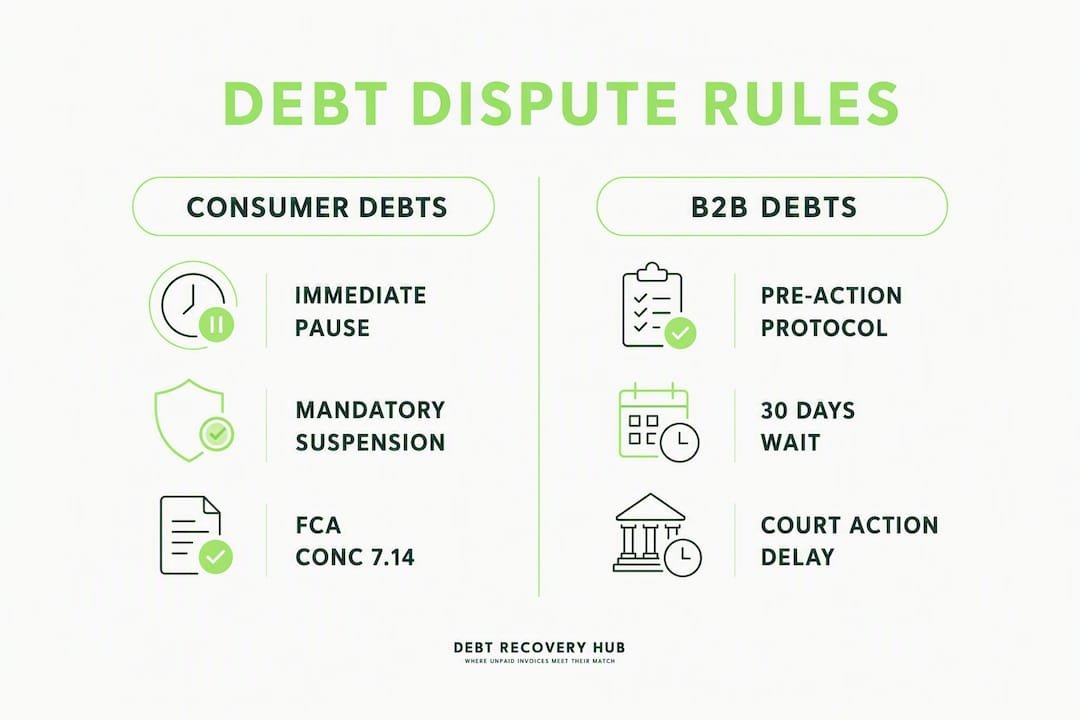
Consumer-regulated debts (FCA CONC 7.14 applies):
- Suspend recovery immediately on receipt of a dispute, regardless of whether you believe the grounds are valid
- Investigate and provide the debtor with details of the debt in a timely manner
- FCA Consumer Duty places responsibility on firms according to their actual influence on outcomes — agents cannot hide behind contractual labels
- No field visits, further demands, or credit file updates while the dispute is live and uninvestigated
B2B debts (Pre-Action Protocol for Debt Claims applies):
- Send a Letter of Claim with the required information before issuing proceedings
- Allow the debtor a suitable minimum period after a completed Reply Form or from the provision of requested documents before starting court action
- Exchange documents promptly; courts can impose costs on parties who skip these steps
- Statutory demands remain available but carry significant risks (see escalation section below)
The practical difference is stark. A consumer dispute triggers an immediate mandatory pause. A B2B dispute triggers a structured pre-action process with defined notice periods. Conflating the two is a compliance risk in one direction and a tactical error in the other.
What should your dispute communications actually say?
Templates give you consistency; the right tone keeps the relationship recoverable.
Acknowledgement letter (key elements):
- Confirm receipt of the dispute and the date received
- State that recovery steps are paused (where FCA CONC applies) pending investigation
- List the documents or information you need from the debtor
- Give a clear deadline (14 days is standard; 30 days for complex B2B cases)
- Provide a named contact and secure channel for the debtor’s response
Evidence request wording: “We are writing to acknowledge your dispute dated [date]. We have paused recovery activity while we investigate. To progress this matter, please provide [specific documents] by [date]. We will supply you with a copy of the original agreement and statement of account within [X] working days.”
Settlement acceptance: Confirm the agreed amount, payment schedule, and that the dispute is resolved on those terms. State explicitly that no further recovery action will be taken provided payments are maintained.
- Use secure email or recorded post for all dispute correspondence
- Keep a contemporaneous log: date, channel, content, and recipient
- Write as though every letter will be read by a judge — because it might be
How do you formalise an accepted repayment plan?
An oral agreement is not enough. Converting an accepted offer into a written repayment arrangement protects both parties and satisfies FCA expectations on ethical debt collection.
Key elements of a written repayment agreement:
- Full names and addresses of both parties
- The agreed outstanding balance (not the original claimed amount if a reduction was accepted)
- Instalment amounts, due dates, and payment method
- Consequences of default (typically reversion to the full balance)
- Signature or written confirmation from both parties
Where you act as an agent for a lender, FCA guidance expects payments and balance details to be passed to the original lender within five working days of receipt. Keep a record of every payment received, the date it was passed on, and who authorised acceptance of the settlement.
Pro Tip: Use a conditional release clause: the debt is formally discharged only once all instalments are received. Issue a receipt for each payment and a final discharge letter when the arrangement completes. This eliminates the most common source of post-settlement disputes.
When should you escalate, and what are the risks?
Escalation is a last resort, not a first response. The decision should turn on three factors: the strength of your evidence, the amount at stake, and the debtor’s apparent solvency.
Alternatives to immediate litigation:
- Structured negotiation or a without-prejudice settlement offer
- Mediation through a recognised ADR provider
- Referral to the Financial Ombudsman Service for regulated consumer debts
Statutory demands and insolvency tools:
A statutory demand is appropriate for debts above certain financial thresholds but only where the debt is genuinely undisputed. Using one against a debtor with a bona fide dispute risks the demand being set aside and exposes you to an adverse costs order. Courts subject winding-up petitions to close scrutiny; a petition founded on a disputed debt is likely to be dismissed.
“Misuse of statutory demands and insolvency petitions can backfire and cause substantial cost and reputational harm — these tools are for undisputed debts, not leverage.” — LEXLAW commercial debt recovery guide
Skipping pre-action steps before issuing a court claim can result in the court staying proceedings and ordering you to pay the debtor’s costs, regardless of whether your underlying claim is valid.
How do you prevent disputes from arising in the first place?
Prevention costs less than litigation. The businesses that rarely face disputes share three habits: bespoke contracts, rigorous intake checks, and centralised records.
Contract drafting checklist:
- Define scope, deliverables, and payment milestones with precision
- Include a dispute-resolution clause naming the process (negotiation, then mediation, then litigation)
- State governing law and jurisdiction explicitly
- Avoid boilerplate — generic templates miss the specifics that matter in your sector
Operational process steps:
- Conduct credit and identity checks before extending credit
- Obtain signed delivery or completion records for every transaction
- Store all documents in a centralised system with version control and access logs
- Set a document retention policy of at least six years to cover the limitation period
- Issue accurate, itemised invoices promptly and reconcile accounts monthly
- Use bespoke invoice templates that reference the contract number and agreed terms
Marcus Williams, commercial lawyer, noted that “by taking time to conduct due diligence, agreeing clear payment terms, and including practical enforcement provisions, businesses can significantly reduce the risk of late or non-payment.”
Key takeaways
Handling debtor disputes correctly requires immediate suspension of recovery where FCA CONC 7.14 applies, prompt written acknowledgement, structured document exchange, and formal written agreements for any accepted settlement.
| Point | Details |
|---|---|
| Suspend recovery immediately | FCA CONC 7.14 requires firms to pause all recovery steps when a consumer disputes on valid or potentially valid grounds. |
| Follow Pre-Action Protocol for B2B | Allow at least 30 days from a completed Reply Form or from the provision of requested documents before starting court proceedings. |
| Exchange documents early | Early disclosure frequently resolves disputes without litigation and avoids court cost penalties. |
| Formalise every settlement in writing | Written repayment agreements with signed terms prevent post-settlement disputes and satisfy FCA expectations. |
| Use Debtrecoveryhub for specialist matching | Debtrecoveryhub connects creditors with vetted agencies experienced in compliant dispute handling across debt type and sector. |
Why most dispute problems are really process problems
The disputes that escalate to litigation almost always have the same origin: a creditor who skipped a step, a contract that was vague, or an agent who kept chasing after a dispute was raised. The FCA’s broad interpretation of “valid grounds” under CONC 7.14 means that almost any coherent objection from a consumer triggers the pause-and-investigate duty. Firms that treat this as a bureaucratic hurdle rather than a genuine investigative obligation tend to accumulate complaints, ombudsman referrals, and adverse cost orders.
What practitioners underestimate is how often early document exchange resolves a dispute that looked intractable. A debtor who claims they never received the goods frequently changes position when you produce a signed delivery note. A debtor who claims the amount is wrong often accepts the figure once you send a reconciled statement. The Pre-Action Protocol exists precisely because courts know this — it is not just procedural formality, it is a settlement mechanism.
The other underestimated risk is statutory demands. They feel like a power move. In practice, against a debtor with any arguable defence, they hand the debtor a platform to set the demand aside, recover their costs, and reframe the narrative. Reserve them for genuinely undisputed debts where the debtor is simply refusing to pay.
Matched to the right agency from the start
Disputes slow recovery. The right agency, matched to your specific debt type and sector, handles them faster and with fewer compliance risks than a generalist firm working from a standard script.

Debtrecoveryhub connects UK businesses, landlords, and organisations with vetted collection agencies selected on debt type, amount, age, and location. Rather than searching for an agency and hoping it has experience with disputed commercial debts or regulated consumer accounts, you submit your case details and receive a matched referral to a specialist who knows the relevant rules.
- Custom matching based on your debt profile, not a generic directory listing
- Agencies vetted for FCA compliance and dispute-handling experience
- Case intake support to ensure your documentation is in order before referral
- Suitable for business debts, property-related arrears, and specialist cases
If a dispute is already live, getting the right agency involved early can be the difference between a negotiated settlement and a costly court claim. Submit your case details to find a matched agency, or review the full services available on the platform.
Useful sources
The sources below are the primary references for the rules and procedures covered in this article. Keep copies of the regulatory texts in your compliance library and check them for updates.
| Source | What it covers |
|---|---|
| FCA CONC 7.14 | Mandatory suspension and investigation duties for consumer-regulated disputed debts |
| Pre-Action Protocol for Debt Claims | B2B pre-action steps, document exchange, and minimum notice periods |
| FCA Consumer Duty portfolio letter | Firm and agent responsibilities under Consumer Duty in dispute handling |
| LEXLAW commercial debt recovery guide | Statutory demand thresholds, risks, and practical escalation guidance |
| FCA CONC 7 | Agent obligations on passing payments and balance details to lenders |
Regulatory texts are updated periodically. Always verify the current version of FCA CONC rules via the FCA Handbook before relying on them in compliance procedures.
FAQ
What does FCA CONC 7.14 require when a consumer disputes a debt?
FCA CONC 7.14 requires firms to suspend all recovery steps immediately when a customer disputes a debt on valid or potentially valid grounds, and to investigate and provide details of the debt in a timely manner.
How long must you wait before starting court action in a B2B dispute?
Under the Pre-Action Protocol for Debt Claims, you must allow at least 30 days from a completed Reply Form or from the provision of requested documents before issuing proceedings.
Can you use a statutory demand against a debtor who has raised a dispute?
No. Statutory demands should only be used for genuinely undisputed debts. Using one against a debtor with a bona fide dispute risks the demand being set aside and an adverse costs order against you.
What is the five-working-day rule for agents handling payments?
Where a firm acts as agent for a lender, FCA guidance expects payments and balance details to be passed to the original lender within five working days of receipt, with a full audit trail retained.
How can Debtrecoveryhub help with disputed debt cases?
Debtrecoveryhub matches your case to a vetted collection agency with relevant experience in your debt type and sector, reducing the risk of compliance errors and improving the likelihood of a negotiated resolution.