



TL;DR:
- UK businesses can automatically claim interest at 8% above the Bank of England base rate on overdue invoices, along with fixed compensation based on debt size. These rights, established under the 1998 Act, do not require court orders and apply to business-to-business transactions within strict time limits. Proper documentation and timely action increase the chances of recovering late payment charges effectively.
UK suppliers can charge statutory interest at 8% above the Bank of England base rate on overdue commercial invoices, plus a fixed compensation sum of £40, £70, or £100 per invoice depending on the debt value. Both sums are automatic legal rights under the Late Payment of Commercial Debts (Interest) Act 1998 — you do not need a court order to claim them.
Here is what you can charge at a glance:
- Statutory interest: 8% plus the Bank of England base rate, accruing from the day after the due date until the invoice is paid.
- Fixed compensation: £40 (debt under £1,000), £70 (£1,000–£9,999.99), or £100 (£10,000 or more) per qualifying invoice.
- Additional recovery costs: if your actual recovery costs exceed the fixed sum, you can claim the difference — provided you can evidence it.
“Under the Late Payment of Commercial Debts (Interest) Act 1998, you have an automatic right to claim interest and compensation on overdue commercial invoices. You do not need to have included a late payment clause in your contract for these rights to apply.”
— Small Business Commissioner, A Guide to Payment Rights for Small Businesses
Table of Contents
- How statutory interest works: rate, timing and exceptions
- Fixed statutory compensation: the three tiers explained
- How to calculate what you are owed: formula and worked example
- How to claim late payment interest and compensation: step by step
- When statutory rights may not apply: limits and disputes
- Authoritative sources to rely on when making a claim
- Key takeaways
- Why most businesses underestimate what they can actually recover
- When self-help stops working, Debtrecoveryhub can step in
- FAQ
How statutory interest works: rate, timing and exceptions
The rate is straightforward: 8% above the Bank of England base rate, applied as simple (not compound) interest. It runs from the day after the payment was due until the date the customer actually pays.
Determining the “relevant day” matters more than most finance teams realise. If you agreed a specific payment date in writing, interest starts the day after that date. Where no date was agreed, the Late Payment Act sets a 30-day default: interest begins 30 days after whichever is later — the invoice date, the date the customer received the invoice, or the date goods or services were delivered. Public authorities operate under different rules and are generally required to pay within 30 days.
“Statutory interest is implied into qualifying contracts; parties may only exclude or vary it by providing a substantial contractual remedy in its place.”
— Late Payment of Commercial Debts (Interest) Act 1998
A contract can displace statutory interest, but only if it offers a genuine, substantial alternative remedy — not a token clause. Unfair terms that attempt to strip the right entirely are unlikely to hold. The Act applies to business-to-business contracts; it does not cover consumer sales.
Fixed statutory compensation: the three tiers explained
The Late Payment of Commercial Debts (Interest) Act 1998, section 5A sets three fixed compensation bands, applied per qualifying invoice:
| Debt value | Fixed compensation |
|---|---|
| Under £1,000 | £40 |
| £1,000 to £9,999 | £70 |
| £10,000 or more | £100 |
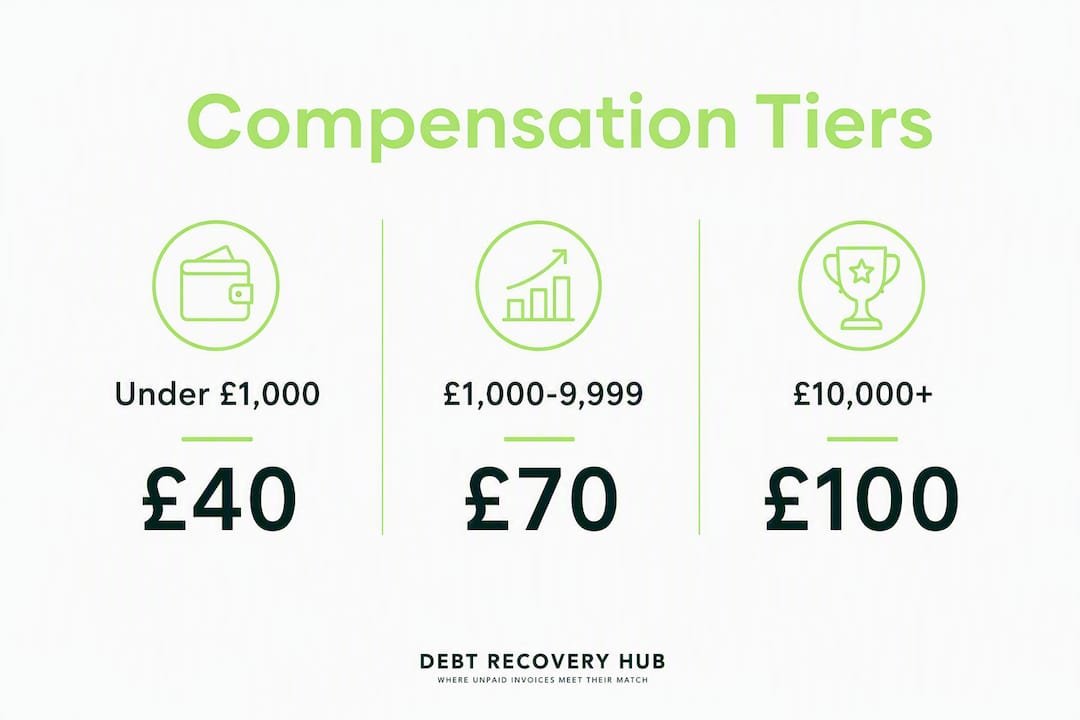
Compensation is separate from interest — you claim both. Critically, it applies per invoice, not per debtor. If a single customer owes you on five separate invoices, you can claim the fixed sum five times.
Where your actual recovery costs — solicitor fees, agency charges, credit control time — exceed the fixed sum, you can claim the difference provided you can evidence those costs with documentation.
Pro Tip: Keep a log of every hour spent chasing a debt, including staff time and any third-party costs. If your recovery costs exceed £100, that log becomes the basis for a higher claim.
How to calculate what you are owed: formula and worked example
The formula for statutory interest is:
Invoice total (inc. VAT) × (Bank of England base rate + 8%) × days late ÷ 365

Always use the VAT-inclusive invoice total. The Small Business Commissioner’s interest calculator applies the Bank of England base rate as it stood on 30 June (for debts running July–December) or 31 December (for debts running January–June), so the rate used in your calculation may differ slightly from the current rate depending on when the debt arose.
Worked example:
| Item | Value |
|---|---|
| Bank of England base rate (assumed) | 4.5% |
| Statutory interest | — × 12.5% × — ÷ 365 = £89.38 |
| Fixed compensation (£1,000–£9,999 band) | £70 |
If the invoice was subsequently paid late, you can still claim interest and compensation for the period it was overdue — calculate interest up to the date payment was received and issue a separate interest and compensation invoice.
How to claim late payment interest and compensation: step by step
- Calculate the sums owed. Use the formula above or the Small Business Commissioner’s calculator for precision. Include VAT in the invoice total.
- Escalate with a letter before action. If payment is still not received, issue a letter before action giving a final deadline (typically 7–14 days) before court or collection proceedings. Follow the pre-action protocol for debt to avoid procedural issues later.
- Consider mediation — Where the business relationship has value, mediation is faster and cheaper than court. The Small Business Commissioner can assist with dispute resolution before proceedings are issued.
Pro Tip: Gather your original invoice, delivery records, any written contract or purchase order, and the full communication trail before sending any formal demand. Courts and agencies both need this documentation.
When statutory rights may not apply: limits and disputes
The most common reason a claim fails is a contractual override. If your contract contains a substantial remedy for late payment — a genuine interest clause at a comparable rate, for instance — the Act’s statutory interest may be displaced. A clause that simply excludes interest without offering anything in return is unlikely to be enforceable.
GOV.UK guidance confirms that payment terms longer than 60 days are permitted in business contracts only when they are fair to both parties. Terms that are grossly unfair may be unenforceable, allowing statutory interest to apply by default.
Interest cannot be charged on consumer transactions, and a bona fide dispute about the quality or delivery of goods may pause the clock — though it does not extinguish the right entirely once the dispute is resolved.
On time limits: the general limitation period in England and Wales is six years from the date the debt became due. Act promptly. Waiting years to claim interest on a large invoice is legally possible but practically harder to enforce, and the debtor’s financial position may deteriorate.
Authoritative sources to rely on when making a claim
Three sources should sit on every finance team’s desk.
The Late Payment of Commercial Debts (Interest) Act 1998 is the statutory foundation. Every right discussed in this article flows from it. Read sections 1, 2, and 5A in particular.
GOV.UK’s late commercial payments guidance translates the Act into plain English, covers the 30-day default rule, public authority exceptions, and the rate formula. It is the fastest way to verify the current position without reading primary legislation.
“The Small Business Commissioner provides practical tools — including an interest calculator and dispute guidance — specifically designed to help small businesses enforce their statutory rights without immediately resorting to litigation.”
— Small Business Commissioner
The Small Business Commissioner’s interest calculator applies the correct half-year base rate automatically, which removes the most common calculation error. Use it before issuing any demand.
Key takeaways
UK businesses have a statutory right to charge 8% above the Bank of England base rate in interest plus fixed compensation of £40, £70, or £100 per overdue invoice under the Late Payment of Commercial Debts (Interest) Act 1998.
| Point | Details |
|---|---|
| Statutory interest rate | Charge 8% above the Bank of England base rate from the day after the due date until paid. |
| Fixed compensation tiers | £40 (under £1,000), £70 (£1,000–£9,999.99), £100 (£10,000+) per qualifying invoice. |
| Per-invoice rule | Claim the fixed compensation sum separately for each overdue invoice, not once per debtor. |
| Use the official calculator | The Small Business Commissioner’s calculator applies the correct half-year base rate for accurate figures. |
| Debtrecoveryhub referral | For aged or large debts, Debtrecoveryhub matches you with a vetted collection agency by debt type, amount, and location. |
Why most businesses underestimate what they can actually recover
The Late Payment Act is one of the most underused commercial tools in the UK. Most finance teams know about it in theory; far fewer actually issue interest and compensation invoices as a matter of routine. The reason is usually a fear of damaging the relationship — which is understandable, but often misplaced.
A formal interest invoice, issued calmly and professionally with a clear legal basis, signals that your business takes its terms seriously. Debtors who know you will enforce your rights tend to pay faster on subsequent invoices. The businesses that never claim are, in effect, offering an interest-free credit facility to every late payer on their ledger.
The other thing worth saying plainly: mediation is genuinely underrated. Before issuing a court claim, a short mediation session can resolve a disputed invoice in days rather than months, at a fraction of the cost, and without burning the commercial relationship. The Small Business Commissioner can facilitate this. Court should be the last resort, not the first instinct.
Document everything from the moment an invoice goes overdue. A clean paper trail — invoice, delivery confirmation, payment terms, chasing emails — is what turns a legal right into an actual recovery.
When self-help stops working, Debtrecoveryhub can step in
Statutory interest letters and small claims work well for straightforward cases. When a debt is large, old, or the debtor is unresponsive, the picture changes.

Debtrecoveryhub matches UK businesses with vetted debt collection agencies based on the specific details of each case: debt type, amount, age, and debtor location. There is no guesswork in selecting an agency — the platform gathers the case details upfront and recommends the right partner, whether the debt is a domestic commercial invoice, a construction payment dispute, or a cross-border recovery. For finance teams already stretched on credit control, handing a case to a specialist agency through a compliant, ethical referral process is often faster and more cost-effective than pursuing it in-house. Submit your case details at Debtrecoveryhub’s debt collection service to get a tailored agency recommendation.
This article provides general information about UK statutory late payment rights and is not legal advice. Confirm current rates and rules with GOV.UK, the Small Business Commissioner, or a qualified solicitor before taking formal action.
FAQ
Are late payment charges legal in the UK?
Yes. The Late Payment of Commercial Debts (Interest) Act 1998 gives UK businesses an automatic right to charge statutory interest and fixed compensation on overdue commercial invoices, with no court order required.
What is late payment compensation?
It is a fixed statutory sum — £40, £70, or £100 per overdue invoice depending on the debt value — that a supplier can claim in addition to statutory interest to cover the cost of chasing payment.
What is the current statutory interest rate for late commercial payments?
The rate is 8% above the Bank of England base rate, applied as simple interest from the day after the due date until the invoice is paid. Use the Small Business Commissioner’s calculator to apply the correct half-year base rate.
Do I legally have to pay late fees if my customer disputes the invoice?
A genuine, bona fide dispute can affect when interest starts to run, but it does not extinguish the right entirely. Once the dispute is resolved and the debt confirmed, statutory interest and compensation can be claimed for the overdue period.
How long do I have to claim late payment interest?
The general limitation period in England and Wales is six years from the date the debt became due. Acting promptly improves the likelihood of recovery and avoids complications if the debtor’s circumstances change.