



No win no fee collections means you pay the debt collection agency nothing unless they actually recover money from your debtor. The agency takes a pre-agreed percentage of whatever they collect and remits the rest to you. If they collect nothing, you owe nothing. That is the core of the contingency fee model, and it is the arrangement most UK creditors mean when they ask about risk-free debt collection.
Before you place an account, check one thing in the contract: the precise definition of “win.” Some agreements define it in ways that allow partial-recovery charges or administrative fees even when full recovery fails. Agencies that hold Credit Services Association (CSA) membership and handle data under Information Commissioner’s Office (ICO) compliance standards are generally held to higher transparency norms. Debtrecoveryhub matches you with vetted agencies that meet both standards. Start with a free case assessment to find out whether your debt is a good fit.
Table of Contents
- What does no win no fee collections actually mean?
- When does no win no fee collection apply to your debt?
- What are the typical UK fee ranges and hidden costs?
- How does a no win no fee collection engagement actually work?
- What are the real advantages and risks of this model?
- What to check in a no win no fee agreement before you sign
- What are the realistic alternatives to contingency collection?
- How Debtrecoveryhub matches you with the right agency
- Key takeaways
- The part most creditors overlook
- Get a free case assessment via Debtrecoveryhub
- Useful sources
- FAQ
What does no win no fee collections actually mean?
The model is straightforward in principle. The agency and creditor agree a percentage before any work begins. The agency pursues the debt, and if it collects, it deducts its fee from the gross amount recovered before remitting the balance to you. If it collects nothing, you pay nothing.
Contingency fee collections work on this percentage-of-recovery basis, and the arrangement aligns incentives neatly: the agency only earns when you do. A standard placement agreement will typically cover:
- The contingency percentage (and whether it tiers by debt age or balance size)
- The definition of a “win” (full recovery, partial recovery, or first payment only)
- Remittance timing (how quickly net funds are forwarded after collection)
- What happens if the case requires legal escalation
- Reporting frequency and format
One important distinction: “no win no fee” and “no collection, no commission” are not always identical. Some agreements labelled “no win no fee” still permit upfront administrative or legal charges. “No collection, no commission” is the cleaner, more precise term. Always ask for a written fee breakdown before you sign anything.
When does no win no fee collection apply to your debt?
Contingency placement works best for undisputed debts with clear evidence of liability: a signed contract, an unpaid invoice, a delivery confirmation. The debtor acknowledges the debt exists but simply has not paid.
Accounts that typically suit the model:
- Undisputed B2B or B2C invoices with documentary evidence
- Balances large enough that a percentage fee still leaves a meaningful net recovery
- Debts under six years old (within the Limitation Act 1980 window)
- Debtors who are solvent and traceable
Contingency placement is unlikely to be cost-effective or even available for very small balances (where the agency’s commission erases the recovery), time-barred debts, debtors in formal insolvency proceedings, or claims where liability is genuinely disputed and would require litigation to establish.
Pro Tip: Place accounts as early as possible. Recovery probability falls as invoices age, and agencies charge progressively higher contingency rates on older accounts because collectability declines. An account placed at 60 days overdue will almost always attract a lower rate and produce a better net outcome than the same account placed at 18 months. Before you place, consider sending a final pre-instruction letter yourself: some debtors pay immediately when they see a formal notice, saving you the commission entirely.

What are the typical UK fee ranges and hidden costs?
Contingency percentages vary with account age, balance size, and complexity. Larger claims tend to attract lower percentage rates; smaller or aged accounts attract higher ones because the agency is taking on more risk for a less certain outcome.
Contingency percentages vary with account age, balance size, and complexity. Larger claims tend to attract lower percentage rates; smaller or aged accounts attract higher ones because the agency is taking on more risk for a less certain outcome. Typical contingency rates in the UK market range from 10–25% for early-stage accounts, rising to 30–40% for aged or legally escalated cases. Always request a written fee breakdown for your specific account and confirm what counts as a “win.”
Beyond the headline percentage, watch for these extras in writing:
- Tracing fees if the debtor’s address needs locating
- Court filing fees when the case escalates to litigation
- Solicitor disbursements (often charged at hourly rates, separate from the contingency)
- Setup or administration fees on each placed account
A worked example: you place a £5,000 invoice with an agency charging a 20% contingency. If the agency recovers the full amount, you receive £4,000. If court filing fees or other legal costs are not included in the contingency—such as the £205 County Court fee—your net drops further. On a £500 invoice at the same rate, you would net £400 before any extras. At that level, the maths of contingency placement deserves scrutiny.
Larger claims justify contingency models more clearly because the percentage fee represents a smaller share of a meaningful recovery. For small-balance portfolios, the arithmetic often favours flat-fee or in-house approaches instead.
Some agencies offer a hybrid model: a small per-account fee for early-stage work plus a reduced contingency on successful recovery. This suits mixed-age portfolios where you want active pursuit on every account without paying full contingency rates across the board.
How does a no win no fee collection engagement actually work?
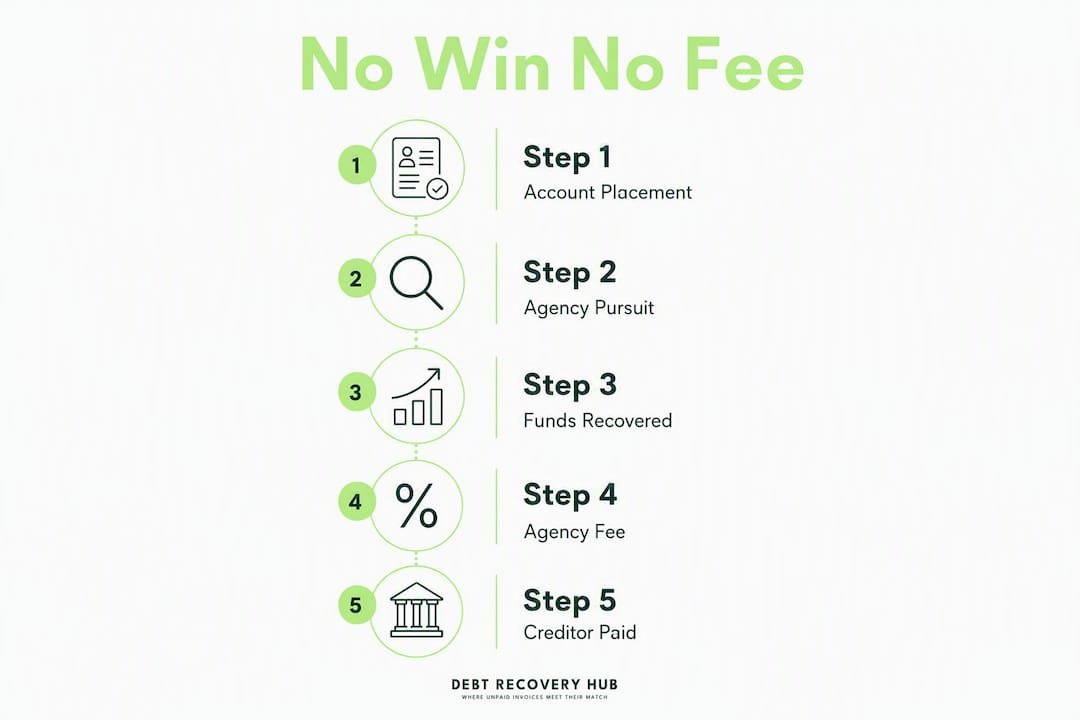
The process from placement to remittance follows a broadly consistent pattern across reputable UK agencies.
- Case assessment and intake. You submit the debt details: invoice date, amount, debtor contact information, and supporting documents (contract, invoice, correspondence). The agency assesses solvency, traceability, and viability.
- Placement agreement. Both parties sign the contingency agreement, confirming the fee percentage, definitions, and escalation terms.
- Early-stage collection. The agency sends formal demand letters and makes telephone contact. This phase typically runs for 30–60 days on a fresh account.
- Formal collection. If early-stage contact fails, the agency escalates to more formal written demands and may involve a pre-legal team. This phase can run a further 30–60 days.
- Pre-legal and legal escalation. For accounts that remain unpaid, the agency may recommend issuing a County Court Claim or instructing a solicitor. Court and solicitor costs at this stage are often outside the original contingency unless the contract explicitly includes them. Check the pre-action protocol requirements before this step.
- Remittance or case closure. On successful recovery, the agency deducts its fee and remits the net balance, accompanied by an itemised remittance statement showing gross collected, fee withheld, and net forwarded per account. If recovery fails, the case is closed with no charge.
Good agency transparency means receiving itemised statements at every remittance, not just a net figure. Remittance statements should show gross collected, fee withheld, and net forwarded per account as standard practice. If an agency cannot or will not provide this, treat it as a red flag.
What are the real advantages and risks of this model?

The primary appeal of no win no fee collections is risk-shifting. You avoid upfront spend and only pay when money actually arrives. For businesses with tight cash flow or one-off disputed invoices, that matters.
The genuine advantages:
- No upfront outlay; cash flow is protected until recovery occurs
- Agency incentives align with yours: they earn only when you do
- Access to specialist collection expertise without a retainer
- Frees internal resource from chasing overdue accounts
The risks are real too, and worth naming plainly.
The biggest practical risk is not the contingency percentage itself. It is the costs that sit outside it. Court fees, solicitor disbursements, and tracing charges can accumulate on aged or disputed accounts, and creditors who did not read the contract carefully often discover these only at the invoice stage. A 20% contingency with £500 in unbundled legal costs can cost more than a 30% all-in rate on the same account.
For small-balance portfolios, flat-fee or in-house approaches often deliver better net returns because percentage commissions can erase the recovery entirely on low-value accounts.
Partial recoveries are another consideration. If the agency collects 40% of a disputed invoice and the contract defines that as a “win,” you pay commission on the amount collected. Whether that net figure is acceptable depends entirely on what you agreed upfront.
The accounts that benefit most from contingency placement are undisputed, mid-to-high-value invoices placed early, with a solvent and traceable debtor. The accounts that benefit least are small balances, time-barred debts, and claims where liability is contested.
What to check in a no win no fee agreement before you sign
A placement agreement is a contract. Read it as one.
- Exact contingency percentage and whether it tiers by debt age, balance size, or outcome type.
- Definition of “win” — does it mean full recovery, first payment, or any partial collection?
- Court and solicitor costs — are they included in the contingency, charged separately, or capped?
- Minimum recoverable threshold — is there a balance below which the agency will not act?
- Remittance timing — how quickly after collection does the net amount reach you?
- Reporting frequency — how often will you receive updates and itemised statements?
- Termination rights — can you withdraw an account, and on what notice?
Ask these questions in writing before signing:
- “Please confirm in writing whether court filing fees and solicitor disbursements are included in the contingency percentage or charged separately.”
- “How do you define a successful recovery for the purposes of your commission?”
- “What is your CSA membership number and ICO registration reference?”
Red flags to watch for: vague definitions of “win,” reluctance to provide CSA membership or ICO registration details, no written fee breakdown, and contracts that allow the agency to charge fees on accounts it has not actively worked. Some “no win no fee” arrangements include administrative charges that apply regardless of outcome. Precise contract language protects you.
What are the realistic alternatives to contingency collection?
Contingency placement is not always the right route. The alternatives each have a different cost profile and risk.
Flat-fee early-out collection charges a fixed amount per account regardless of outcome. Flat-fee services give cost predictability that contingency cannot, and for high-volume, low-value portfolios they often produce better net returns. The trade-off is that you pay whether or not the agency collects.
Solicitor on a Conditional Fee Agreement (CFA) is the legal equivalent of no win no fee. A solicitor pursues a litigable claim and charges only on success, typically a percentage uplift on their base costs. This suits higher-value, legally complex claims where the debtor has assets but is refusing to pay. Note that court disbursements are usually still payable regardless of outcome.
Selling or assigning the debt gives you immediate cash, typically at a significant discount to face value; for an illustrative overview of asset and debt division in the US, see Asset Debt Division – The Law Office of John Vernon Moore, P.A.. You lose the upside of full recovery, but you eliminate all collection risk and effort. For very aged or uncertain debts, a clean exit at a discount can be the most rational choice.
Small claims court (for claims up to £10,000 in England and Wales) is a low-cost, self-managed route. Court fees are relatively modest and recoverable if you win, but the process requires your time and the debtor must be solvent enough to pay a judgment.
Hybrid models (a small upfront fee plus reduced contingency) suit mixed-age portfolios where you want active pursuit on every account without paying full contingency rates on the aged ones. Emerging AI-enabled collection alternatives also report lower fee bands for early-stage B2B accounts, worth considering for high-volume portfolios.
For complex cross-border cases, the cost and legal framework differ materially. See Debtrecoveryhub’s guidance on international debt recovery for UK businesses pursuing overseas debtors.
How Debtrecoveryhub matches you with the right agency
Debtrecoveryhub is a matching platform, not a collection agency. It connects UK creditors with vetted debt collection agencies selected for their debt type, balance size, account age, and location, so you are not cold-calling agencies and hoping for the best.
The process:
- Submit your case details: debt type, amount, age, debtor location, and supporting documentation
- Debtrecoveryhub categorises the case and identifies appropriate partner agencies
- You receive a match with agencies that have relevant specialism and a track record for your account type
- The case assessment is free; you never pay Debtrecoveryhub directly
Trust signals built into the platform:
- Partner agencies are vetted for CSA membership and ICO compliance
- Fee transparency is a condition of the match: agencies must provide a written fee breakdown
- The platform checks for industry memberships and regulatory standing before referral
What to have ready before your assessment: the original invoice or contract, the date the debt became overdue, any written acknowledgement of the debt from the debtor, and the debtor’s current contact details. The more complete your documentation, the faster and more accurate the agency match.
Debtrecoveryhub’s ethical debt collection standards apply to every partner agency in the network, covering conduct, communication, and compliance.
Key takeaways
No win no fee collections is a risk-free debt recovery model where you pay only on successful collection, but the contract terms, hidden costs, and account profile determine whether it is the right route for your debt.
| Point | Details |
|---|---|
| Definition of the model | You pay a percentage of recovered funds only; no recovery means no fee. |
| Hidden cost risk | Court fees and solicitor disbursements often sit outside the contingency; always confirm in writing. |
| Account fit | Undisputed, mid-to-high-value invoices placed early produce the best net outcomes. |
| Contract must-check | Confirm the precise definition of “win” before signing any placement agreement. |
| Debtrecoveryhub | Matches UK creditors with vetted, CSA-compliant agencies via a free case assessment. |
The part most creditors overlook
Most articles on contingency collections focus on the percentage. That is the wrong thing to fixate on.
A lower headline rate from an agency with no sector specialism, no regional reach, and no pre-legal infrastructure will almost always produce a worse net outcome than a higher rate from an agency that knows your debtor type and has a solicitor on speed dial. The fee is a share of what is recovered. If the agency recovers nothing, the rate is irrelevant.
What actually determines your net recovery is the agency’s track record on accounts like yours, the quality of their pre-legal process, and whether their contract is transparent about costs. An agency that charges 30% all-in, with court costs included and a clear definition of “win,” is a better deal than one charging 20% with a contract full of carve-outs.
The other thing creditors consistently underestimate is timing. Every month an invoice sits unplaced, the debtor’s circumstances can change: they move, they trade insolvent, they accumulate other creditors ahead of you. Placement at 60 days is not aggressive; it is rational. The creditors who wait until 18 months and then expect a contingency agency to work miracles are usually disappointed.
Get a free case assessment via Debtrecoveryhub
Recovering unpaid debt without upfront cost is possible, but only if you are matched with an agency that actually specialises in your account type. That is the gap Debtrecoveryhub fills.

Submit your case details at Debtrecoveryhub’s debt collection page and receive a match with a vetted, CSA-compliant agency suited to your debt type, balance, and location. The assessment is free, there is no charge to you for the match, and you will receive a written fee breakdown from any agency before you commit. Have your invoice date, outstanding amount, and any written acknowledgement of the debt ready to speed the process.
This article provides general information about debt collection in the UK and does not constitute legal or financial advice. Confirm current rules and your specific position with a qualified professional or the relevant regulatory body.
Useful sources
| Source | Why it matters |
|---|---|
| Credit Services Association (CSA) | The UK trade body for the debt collection industry; membership signals professional standards and a code of conduct. |
| Information Commissioner’s Office (ICO) | Regulates data protection; any agency handling debtor data must be ICO-registered. |
| MoneyHelper (gov.uk) | Free, impartial guidance on debt and financial options for individuals and small businesses. |
| AgentCollect: contingency fee glossary | Plain-language explanation of how contingency fees work and typical percentage ranges. |
| SW Recovery: fee structures explained | Compares contingency and flat-fee models with practical guidance on net recovery outcomes. |
Debtrecoveryhub vets every partner agency for CSA membership and ICO registration. For disputed or high-value claims, seek independent legal advice before placement.
FAQ
What is no win no fee debt collection?
No win no fee debt collection is a contingency arrangement where the agency takes a pre-agreed percentage of recovered funds and charges nothing if recovery fails. You pay only on success.
What percentage do no win no fee collection agencies typically charge in the UK?
Rates vary with account age, balance size, and complexity. Early-stage accounts attract lower rates; aged or legally escalated accounts attract higher ones. Always request a written fee breakdown before placement.
Are court fees included in the contingency percentage?
Not always. Court filing fees and solicitor disbursements are frequently charged separately from the headline contingency rate. Confirm in writing whether these costs are included or additional before signing.
How is Debtrecoveryhub different from a collection agency?
Debtrecoveryhub is a matching platform, not an agency. It connects creditors with vetted, CSA-compliant agencies suited to their specific debt type, balance, and location, and the case assessment is free.
When should I consider an alternative to no win no fee collections?
For very small balances, time-barred debts, or highly disputed claims, flat-fee collection, small claims court, or selling the debt may produce a better net outcome than contingency placement.